Crusades
In the video "Crusades," by Mr. Corwin, available on YouTube (9:35), a middle-school history teacher explains it all, with good visuals. It is appropriate for use on day 3.
219 results
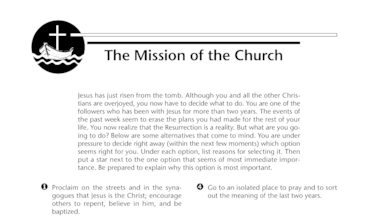
Jesus has just risen from the tomb. Although you and all the other Christians are overjoyed, you now have to decide what to do. You are one of the followers who has been with Jesus for more than two years. …


The song/video "Jesus the Lord,” by Roc O’Connor and the Saint Louis Jesuits," available on YouTube (6:24) with lyrics, is best used on day 4.
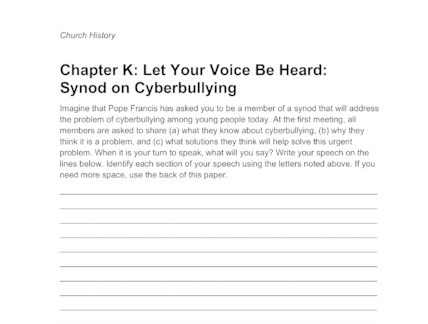
Students are challenged to write a speech as if they were a member of Pope Francis’ synod addressing the problem of cyberbullying.
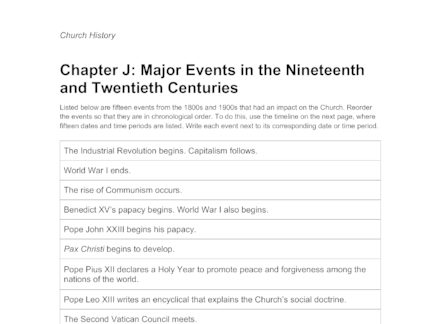
Students order important events from the 19th and 20th centuries.
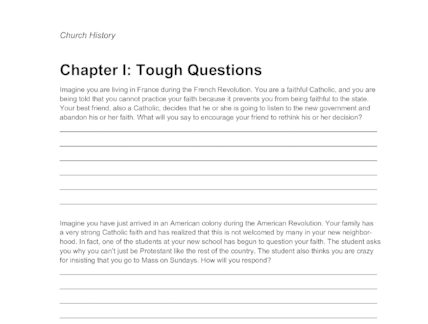
The worksheet poses several questions that ask students to reflect on how they would have stood up for their faith during the French and American Revolution.
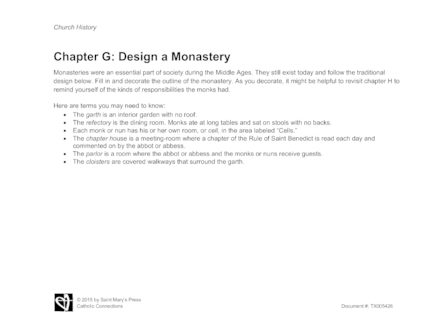
Students design a monastery based on the responsibilities and needs of the monks.
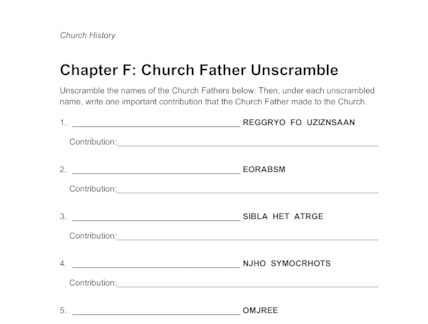
Unscramble the names of the Church Fathers below. Then, under each unscrambled name, write one important contribution that the Church Father made to the Church.
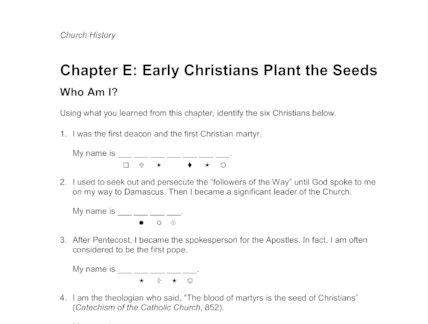
On this worksheet, students solve clues to list the names of important early Christians. These answers are then used to decode a secret message.

The video "Pope Francis Joins Religious Leaders of Different Faiths, in Fight against Modern Slavery," by Rome Reports, available on YouTube (3:07), shows people of faith working together to eliminate one of the world’s greatest evils, slavery. It is best …

The video "Pope Francis in Action," by Catholic News Service, available on YouTube (1:26), features the Pope at World Youth Day 2013. It is best used on day 3 or day 4.

The video "Pope Francis Speaks," by Catholic News Service, available on YouTube (9:27), is a video of the Pope’s remarks from the balcony of Saint Peter’s on the night of his election. It is best used on day 3.

The video "Pope Paul VI—The Pilgrim Pope," by Salt and Light, available on YouTube (2:37), chronicles Pope Paul VI’s role in the Second Vatican Council, increasing Christian unity—including lifting the excommunication of the Greek Orthodox Patriarch—and bringing the Good News …
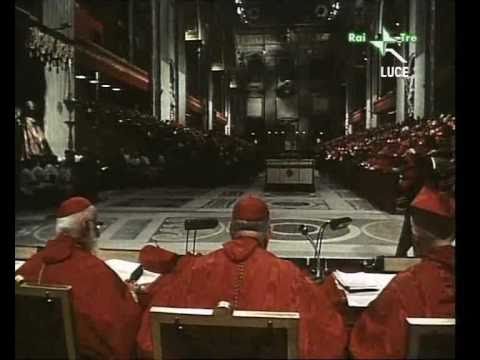
The video "Vaticanum Secundum (Opening of the Second Vatican Council)," by Caeremoniale Romanum, available on YouTube (3:33), is the opening ceremony of Vatican Council II. The first of three videos. In Italian (no subtitles), but the pictures are worth a …

The video "The Catholic Church during World War II," by heptagonofnerds, available on YouTube (2:47), is done by a teen and addresses the issue of the Catholic Church and the Jews. It presents realistically what Pope Pius XII and the …

The video "St. Thomas More," by catholicnewsagency, available on YouTube (2:01), shows the strong Catholic faith of Saint Thomas More and how he stood up to King Henry VIII instead of recognizing the Church of England. It is best used …
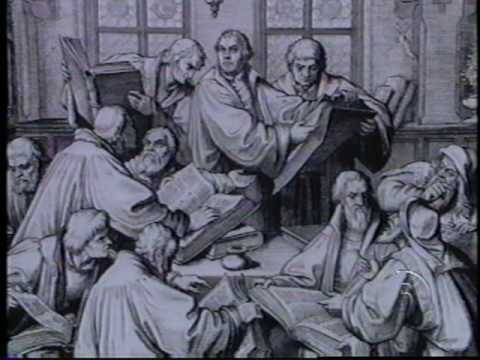
The video "Turning Points in History—The Reformation," available on YouTube (2:28), is a good presentation of the conflict between Martin Luther and the Catholic Church. It is best used on day 2.

In the video "Crusades," by Mr. Corwin, available on YouTube (9:35), a middle-school history teacher explains it all, with good visuals. It is appropriate for use on day 3.
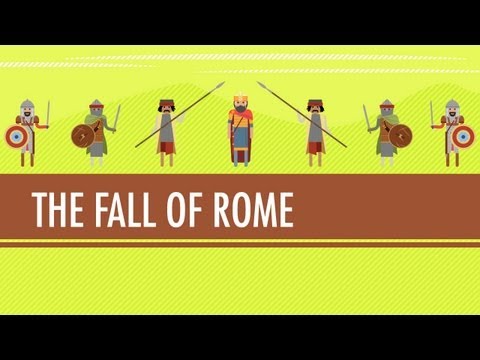
The video "Fall of the Roman Empire," available on YouTube (12:44), is an entertaining crash course in Roman history. Two segments show the differences between the Eastern and Western Empires (begin at 5:06) and the Eastern and Western Churches (begin …

The video "The Nicene Creed in Original Greek," proclaimed by Pope Benedict XVI and the Orthodox Patriarch of Constantinople, Bartholomew I, is available on YouTube (2:28) with excellent photos of the two prelates, art, and icons. It is best used …

The video "Catholic History in Less than Five Minutes: (4) The Early Church Fathers," by Pat McNamara, is available on YouTube (4:47). It is best used on day 1.

The video "Jesus Urging His Disciples to Stay Awake," by Turnback to God, available on YouTube (5:32), is an animated account of Jesus at prayer in Gethsemane (an amalgamation of Gospel accounts). It is best used on day 4.
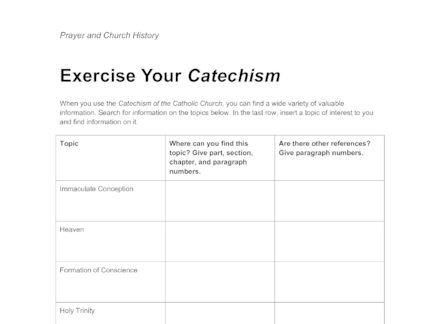
This handout guides students as they become familiar with searching for information in the Catechism of the Catholic Church.
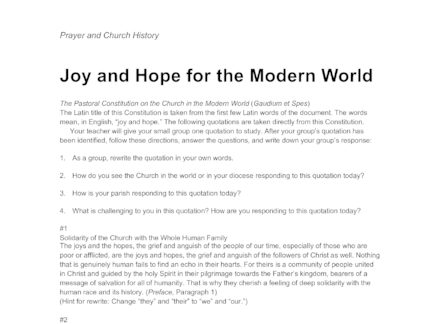
This handout provides questions for students to reflect on and answer as they read quotations from this Constitution.
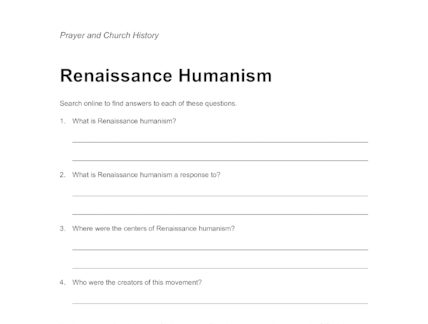
This handout provides questions for students to research on the Internet about Renaissance Humanism.
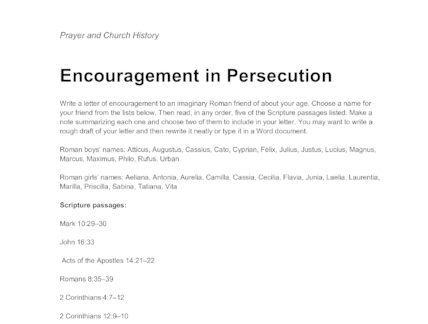
This handout outlines a writing assignment in which students write a letter to an imaginary Roman friend who is enduring persecution in the Empire. Students must use Scripture passages to help them in the writing process.
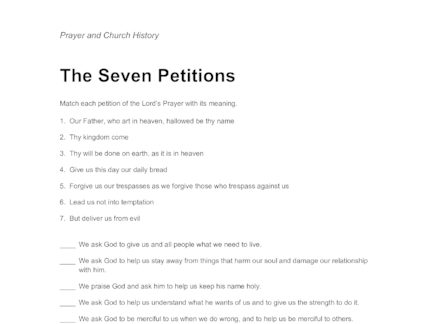
On this handout, students match the meaning to each line of the Lord’s Prayer.
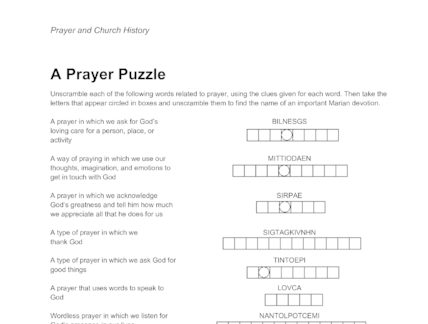
On this handout, students must use clues to unscramble words related to prayer.
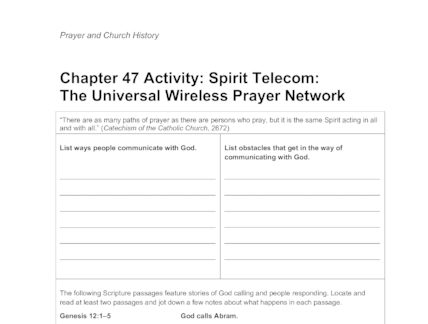
This handout guides students as they locate and read various Scripture passages focusing on the many way God calls us to prayer.
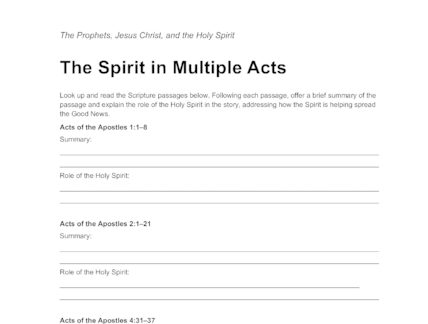
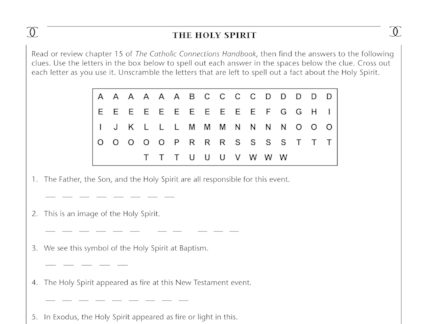
Students look up and read several passages that the Holy Spirit. The worksheet asks students to summarize each passage and describe the role of the Holy Spirit in spreading the Good News.

The song/video "Burning in My Soul," by Matt Maher, available on YouTube (3:45), provides a nice connection to Pentecost and the modern listener and is appropriate for use on day 4.
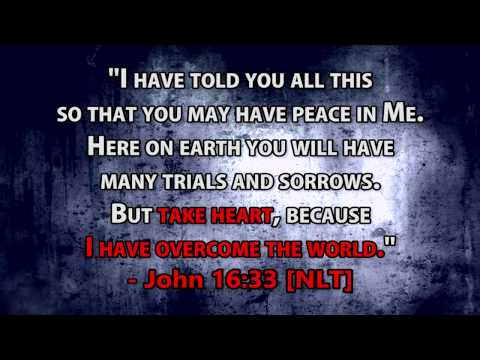
The song/video "Forever (Live)," by Kari Jobe, available on YouTube (6:50) with lyrics, is a good opening prayer for day 4. The video can be shortened to 4:38.

The video "Resurrection Cartoon," available on YouTube (3:05), offers a fun portrayal of the Resurrection and is appropriate for use on day 1.

The video "Mary’s Role in the Catholic Church," available on YouTube (3:52), is used in the "She Is Your Mother" activity on day 2.

The song/video "Mary, Did You Know? (The Bible)," by CeeLo Green, available on YouTube (4:12), incorporates video about the life of Mary and Jesus and is also appropriate for day 1.

The song/video "Mary, Did You Know?" by Pentatonix, available on YouTube (3:24) with lyrics, is an a cappella rendition that is appropriate for day 1.

The video "Mary in 2 Minutes," available on YouTube (2:43), addresses many important questions regarding Mary to support day 1 activities.

The video "The Day of the Dead," available on YouTube (3:49), offers a good overview of the Mexican celebration for the "Day of the Dead" activity on day 4.

The song/video "Christ Is Risen," by Matt Maher, available on YouTube (4:55) with lyrics, can be used for prayer on day 1.
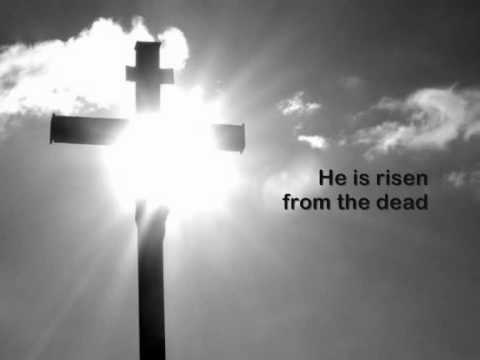
The song/video "I Will Rise," by Chris Tomlin, available on YouTube (5:02) with lyrics, is good for prayer any day this week.

The video "How Can Jesus Be Both God and Human?" available on YouTube (2:42). This short video by Bishop Robert Barron explains the two natures of Jesus and some of the false teachings that the early Christian communities were battling. …

The video "Fully Human, Fully God," by The Skit Guys, available on YouTube (14:37), is used for the "True God and True Man" activity on day 3. Cue to 12:00 for the pertinent 2:37 segment.

The video "Sermon on the Mount: The Beatitudes," available on YouTube (2:08), is used for the "Happy Are You!" activity on day 2. The first 1:15 is sufficient.

The song/video "Blest Are They—The Beatitudes," available on YouTube (8:19), is used for the Engage activity on day 2. The segment between 6:01 and 6:50 focuses on the lesson’s topic of persecution. The first 6:50 is worth showing for context …

The video "The Monastic Life, an Opportunity for the Church," available on YouTube (2:55), provides background material on monastic life for day 3.

A simple search of "vocation stories" on YouTube provides many possibilities. Preselect two or three videos based on your time limitations, student familiarity with certain orders, and potential interest. "The Story of a Voca-tion," posted by OrderofPreachers (3:33), and "Vocation …
The song/video "Go Make a Difference Lyrics," by Steve Angrisano and Tom Tomaszek, available on YouTube (3:03), can serve as opening prayer any day.

The song/video "Hands and Feet," by Audio Adrenaline, available on YouTube (4:04) with lyrics, enhances the Pray It! activity at the start of day 2.

The song/video "Breath of Heaven (Mary’s Song)—The Nativity Story," by Amy Grant, available on YouTube (5:20), tells of the calling of Mary to bring Christ into the world. A video with scenes from the movie The Nativity Story illustrates the …
The song/video "Big House," by Audio Adrenaline, available on YouTube (3:29) with lyrics, offers an alternate, more upbeat opening prayer for any day.

The song/video "One Spirit, One Church," by Kevin Keil and Maryanne Quinlivan, available on YouTube (3:56), offers a good opening prayer for any day this week.

The song/video "1 Timothy 4:12—Seeds Family Worship—‘Young,’" available on YouTube (2:05), is used for the "Be an Example" activity on day 4. The first 1:00 is sufficient.

The song/video "Heaven in the Real World," by Steven Curtis Chapman, available on YouTube (4:20), is used for the "Gear Up" activity on day 3.

The video "Veggie Tales Madame Blueberry," available on YouTube (1:27), is used for the Engage activity on day 2. Consider starting at the 0:24 mark.

The video "C4: Ignite Your Catholic Faith—What Are the Marks of the Church?" is available on YouTube (3:32), and is used for the "On Your Marks" activity on day 1.
The song/video "Run the Race," by Paul Taylor Smith, available on YouTube (4:28), can be used for prayer any day and also complements the "Go the Distance" activity on day 4.

The video "Pope to Youth: ‘Forget about false idols. Only God offers true hope,’" available on YouTube (3:10), is used for the "Think Positive!" activity on day 4. The pertinent quotes begin at the 0:56 mark.

The video "Trip Lee—Reflections on Romans 8," available on YouTube (2:59), is used for the "Clear the Way" activity on day 4.

The song/video "Gospel Music by Shai Linne, 116 Clique (Romans)," available on YouTube (4:55), is used for the “Clear the Way” activity on day 4. Though the video is 4:55, the song concludes at the 4:11 mark. It is helpful …

The video "Acts 15 The Council of Jerusalem," available on YouTube (3:52), is used for the "Paul Is Appalled" activity on day 2.

The Catholic News Service video "Inculturation: The Case of Matteo Ricci," available on YouTube (2:21), provides a clear, concise explanation of enculturation for the chapter project.

The song/video "World Peace Prayer," by Marty Haugen, available on YouTube (4:06), provides a hopeful litany that complements the "Opposites" activity on day 4.
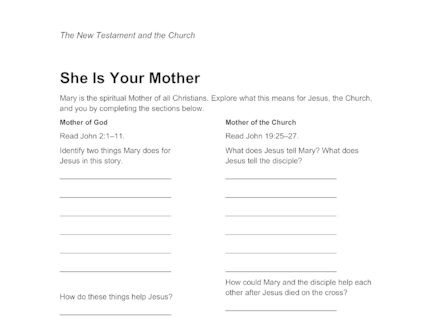
As students complete this worksheet, they will explore what it means when we say that Mary is the Mother of God and the Mother of the Church.
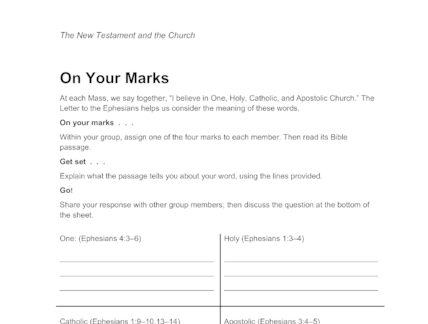
This worksheet guides group members to work together as they identify the importance of the church being “One, Holy, Catholic, and Apostolic”.
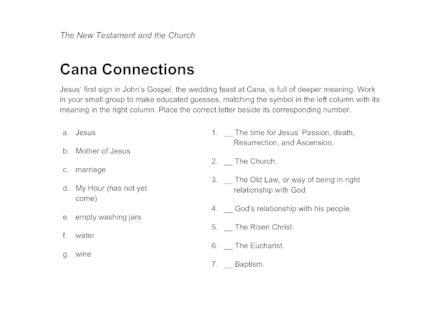
Students match symbols from Jesus’ first miracle the wedding feast in Cana with their meaning and significance.
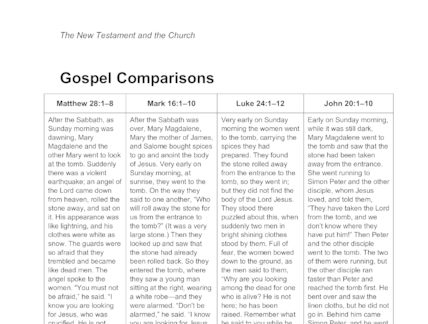
On this worksheet, students read all four Gospel accounts of the resurrection before identifying similarities and differences between them.
This PowerPoint accompanies Chapter B by giving an overview of the Gospel of John.

The video "Matthew 1:1–16: The Genealogy of Jesus Christ," available on YouTube (2:19), is an animation of the lineage of Jesus that shows his connection to the tribe of Judah (see 0:18). It is used on day 3.
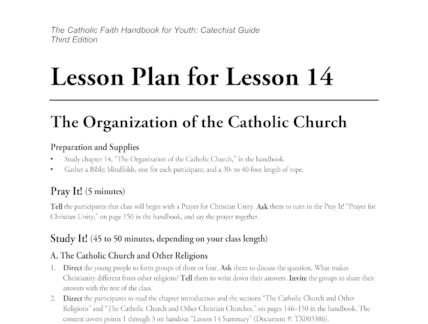
A lesson plan for lesson 14 in The Catholic Faith Handbook for Youth: Catechist Guide.
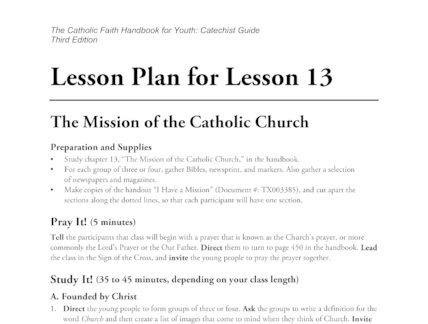
A lesson plan for lesson 13 in The Catholic Faith Handbook for Youth: Catechist Guide.
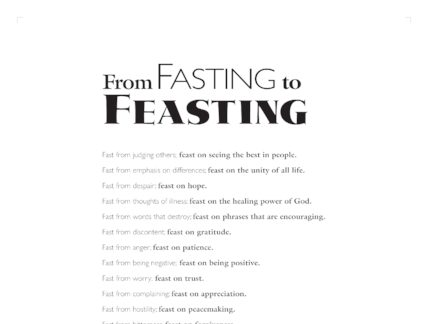
A short prayer that calls us to feast on kindness and compassion towards others.
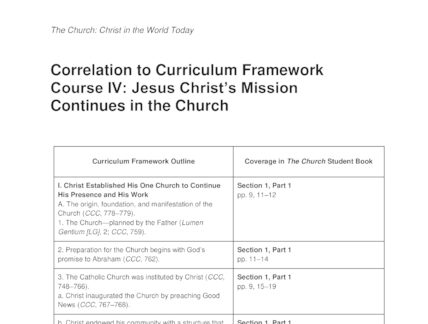
Correlation to Curriculum Framework Course IV: Jesus Christ’s Mission Continues in the Church from The Church: Christ in the World Today.
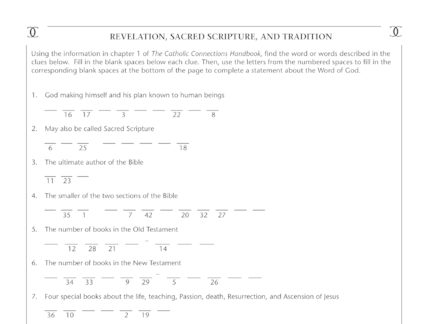
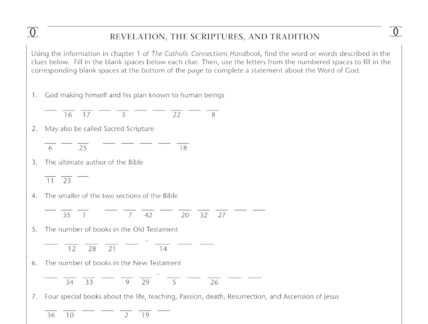
Using the information in chapter 1 of The Catholic Connections Handbook, find the word or words described in the clues below. Fill in the blank spaces below each clue. Then, use the letters from the numbered spaces to fill in …
A brief explanation of tradition versus Tradition. A short video about how Catholic traditions that have been handed down help God reveal himself to us.
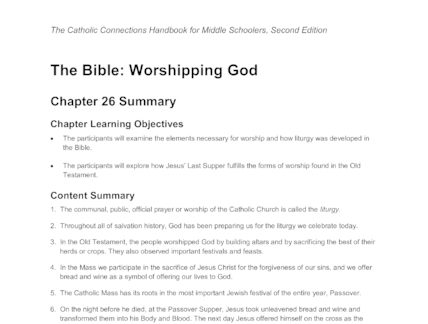
A summary of Chapter 26, The Bible: Worshipping God from the Catholic Connections Handbook for Middle Schoolers, Second Edition.
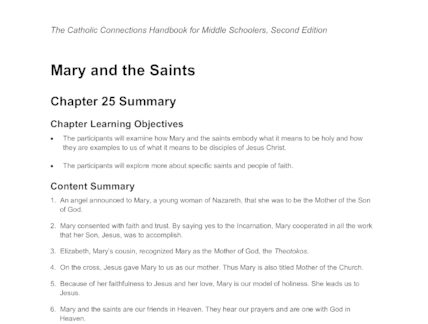
A summary of Chapter 25, Mary and the Saints from the Catholic Connections Handbook for Middle Schoolers, Second Edition.
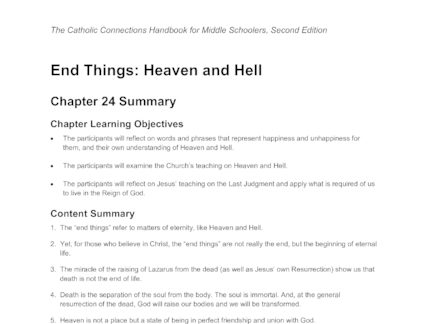
A summary of Chapter 24, End Things: Heaven and Hell from the Catholic Connections Handbook for Middle Schoolers, Second Edition.
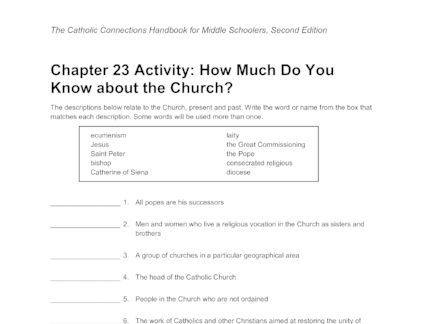
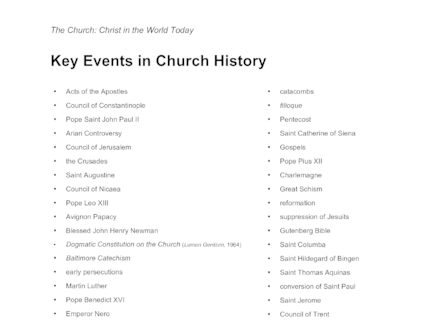
The descriptions below relate to the Church, present and past. Write the word or name from the box that matches each description. Some words will be used more than once.
A summary of Chapter 23, The Structure of the Church from the Catholic Connections Handbook for Middle Schoolers, Second Edition.
A summary of Chapter 22, The Mission of the Church from the Catholic Connections Handbook for Middle Schoolers, Second Edition.
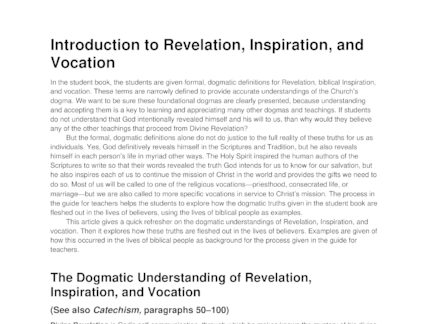
A summary of Chapter 1, Revelation, Sacred Scripture, and Sacred Tradition from the Catholic Connections Handbook for Middle Schoolers, Second Edition.
A personal story about the mission of the Church to share the good news of salvation with others.
A PowerPoint on The Catholic Faith Handbook for Youth, Third Edition Chapter 14, The Organization of the Catholic Church.
A PowerPoint on The Catholic Faith Handbook for Youth, Third Edition Chapter 13, The Mission of the Catholic Church.
A PowerPoint on The Catholic Faith Handbook for Youth, Third Edition Chapter 4, Faith.
A PowerPoint on The Catholic Faith Handbook for Youth, Third Edition Chapter 2, Knowing God: Reason and Revelation.
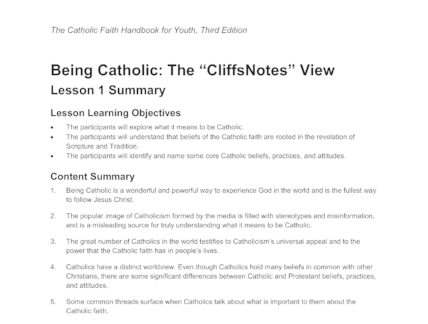
A PowerPoint on The Catholic Faith Handbook for Youth, Third Edition Chapter 1, Being Catholic: The “Cliff Notes” View.
Activities for Chapter 15 The Last Things, including a core activity, core activity extension, and additional activities.
Activities for Chapter 14 The Organization of the Catholic Church, including a core activity, core activity extension, and additional activities.
Activities for Chapter 13 The Mission of the Catholic Church, including a core activity, core activity extension, and additional activities.
Activities for Chapter 4 Faith, including a core activity, core activity extension, and additional activities.
Activities for Chapter 2 Knowing God: Reason and Revelation, including a core activity, core activity extension, and additional activities.
Activities for Chapter 1: Being Catholic, including a core activity, core activity extension, and additional activities.
The Precepts of the Church direct us to participate in the sacramental life of the Church so that we might be nourished for living a moral life. Following are the Precepts of the Church as designated by the Catholic bishops …
Descriptions of how each person of the trinity is present in the liturgy.
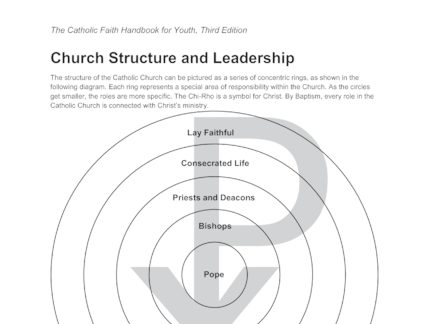
The structure of the Catholic Church can be pictured as a series of concentric rings, as shown in the following diagram. Each ring represents a special area of responsibility within the Church. As the circles get smaller, the roles are …
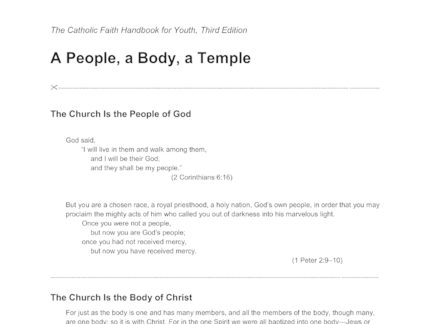
Scripture verses about the Church as the people of God, the body of Christ, and temple of the Spirit.
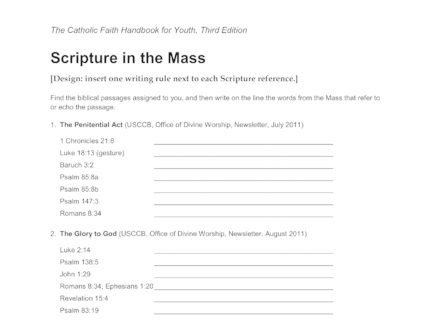
Find the biblical passages assigned to you, and then write on the line the words from the Mass that refer to or echo the passage.
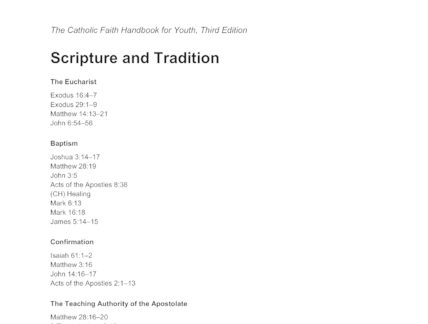
Connections between Scripture passages and Catholic Traditions.
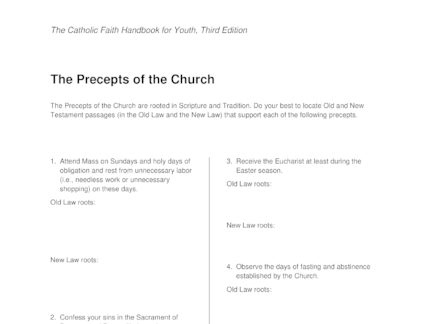
The Precepts of the Church are rooted in Scripture and Tradition. Do your best to locate Old and New Testament passages (in the Old Law and the New Law) that support each of the following precepts.
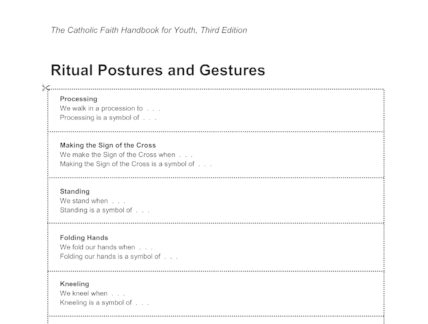
The different postures and gestures that take place during Mass.
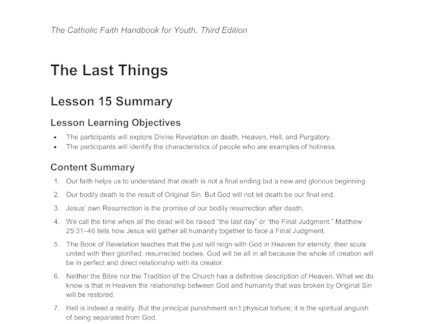
The lesson learning objectives and content summary for Lesson 15, The Last Things.
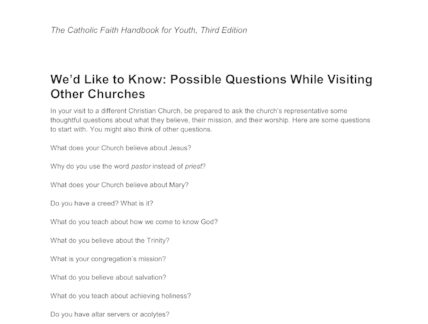
In your visit to a different Christian Church, be prepared to ask the church’s representative some thoughtful questions about what they believe, their mission, and their worship. Here are some questions to start with. You might also think of other …
The lesson learning objectives and content summary for Lesson 14, The Organization of The Catholic Church
The lesson learning objectives and content summary for Lesson 13, The Mission of the Catholic Church.
The lesson learning objectives and content summary for Lesson 12, The Holy Spirit.

The lesson learning objectives and content summary for Lesson 11, Jesus’ Resurrection.
The lesson learning objectives and content summary for Lesson 10, Jesus’ Death.
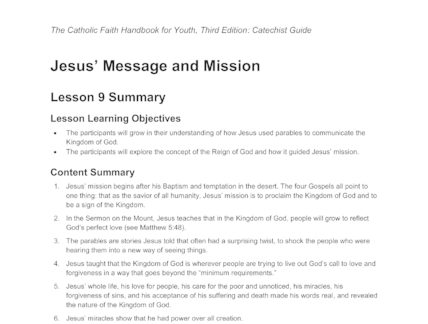
The lesson learning objectives and content summary for Lesson 9, Jesus’ Message and Mission.
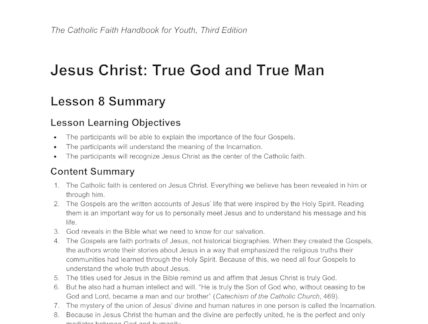
The lesson learning objectives and content summary for Lesson 8, Jesus Christ: True God and True Man.
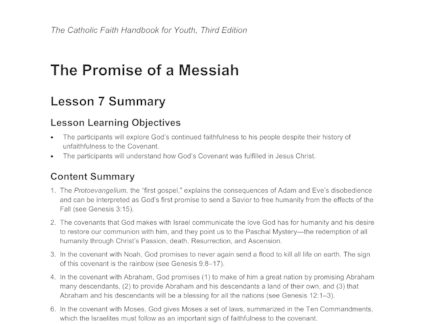
The lesson learning objectives and content summary for Lesson 7, The Promise of a Messiah.
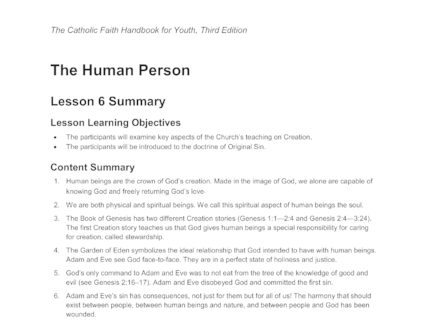
The lesson learning objectives and content summary for Lesson 6, The Human Person.
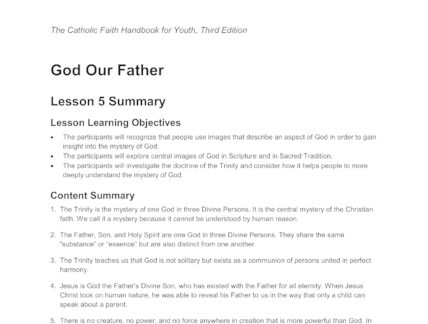
The lesson learning objectives and content summary for Lesson 5, God our Father.
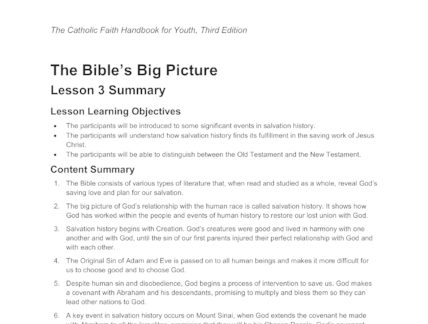
The lesson learning objectives and content summary for Lesson 3, The Bible’s Big Picture.
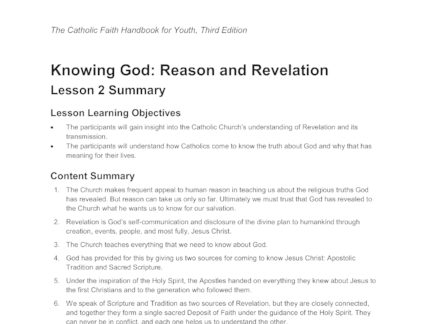
The lesson learning objectives and content summary for Lesson 2, Knowing God: Reason and Revelation.
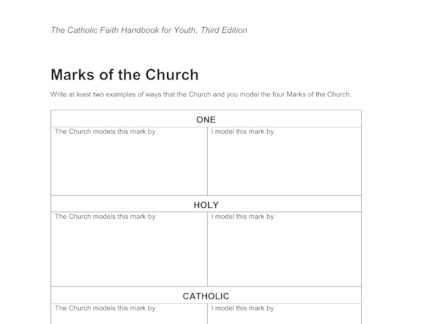
Write at least two examples of ways that the Church and you model the four Marks of the Church.
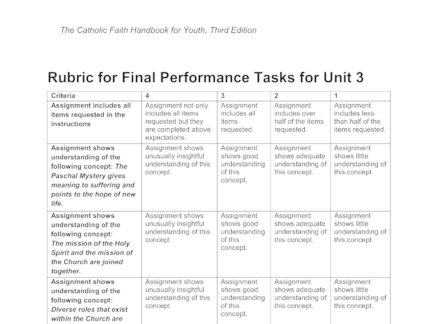
A rubric for the final performance task options for Unit 3 focusing on the Paschal Mystery, the Holy Spirit and the Church, and the mission of the Church. The options include exploring one important ministry in a diverse Church, creating …
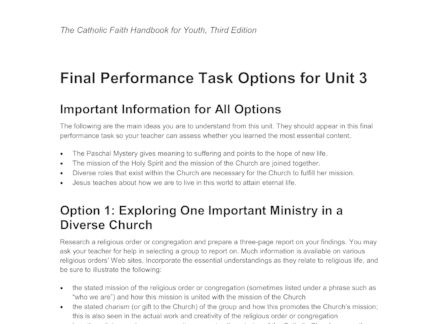
The final performance task options for Unit 3 focusing on the Paschal Mystery, the Holy Spirit and the Church, and the mission of the Church. The options include exploring one important ministry in a diverse Church, creating a poster comparing …
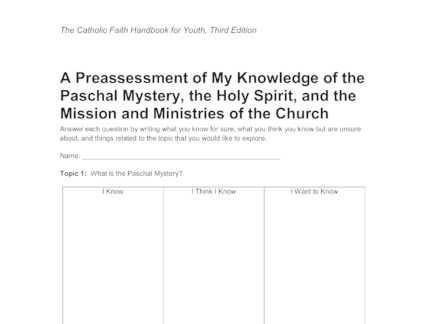
Answer each question by writing what you know for sure, what you think you know but are unsure about, and things related to the topic that you would like to explore.
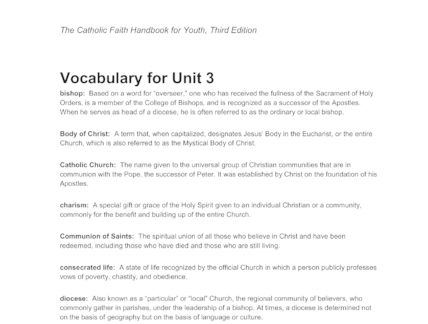
A list of vocabulary words for Unit 3 that defines the terms bishop, Body of Christ, Catholic Church, charism, Communion of Saints, consecrated life, diocese, doctrine, Final Judgment, fruits of the Holy Spirit, Gifts of the Holy Spirit, laity, Marks …
Answer the following questions with your group that are related to the questions asked in the song “One of Us”. Your instructor will lead you through Part II. Use the following questions as prompts for taking notes in your notebook.
All of the Scripture passages used in this exercise are taken from the list in your student book (pages 81–82). These Scripture passages concern covenants or promises that provide an image of hope in a future messiah. As you answer …
You will be guided through this handout, taking notes and answering questions as directed in your class.
In silence, answer all but the last question by yourself. The last question will be answered in small groups.
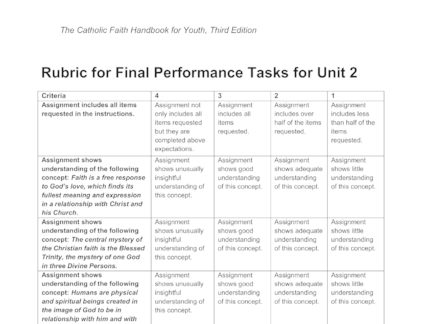
Rubric for grading the final performance tasks for Unit 2 focusing on faith, the Trinity, the Kingdom of God, and creation in the image of God. The options include writing a personal creed, creating a Holy Trinity play, or exploring …
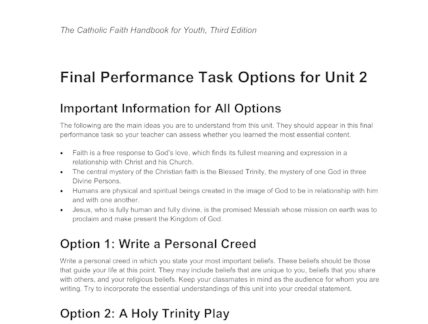
Options of final performance tasks for Unit 2 focusing on faith, the Trinity, the Kingdom of God, and creation in the image of God. The options include writing a personal creed, creating a Holy Trinity play, or exploring three Kingdom …
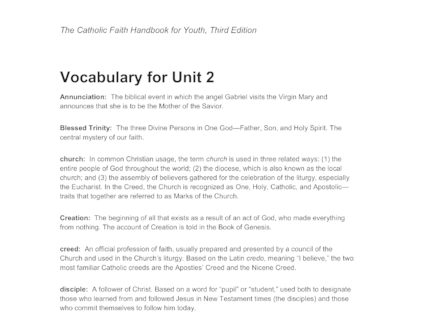
A list of vocabulary words for Unit 2 including Annunciation, Blessed Trinity, church, Creation, creed, disciple, ecumenism, evangelist, faith, Gospel, Incarnation, Kingdom of God, Messiah, ministry, Original Sin, parable, Paschal Mystery, salvation, stewardship, and Theotokos.
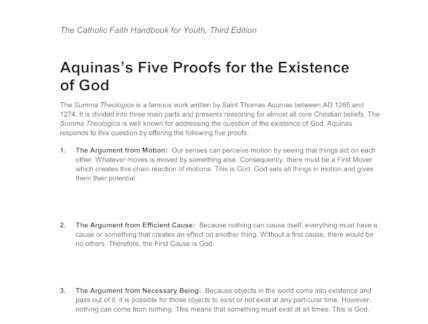
The Summa Theologica is a famous work written by Saint Thomas Aquinas between AD 1265 and 1274. It is divided into three main parts and presents reasoning for almost all core Christian beliefs. The Summa Theologica is well known for …
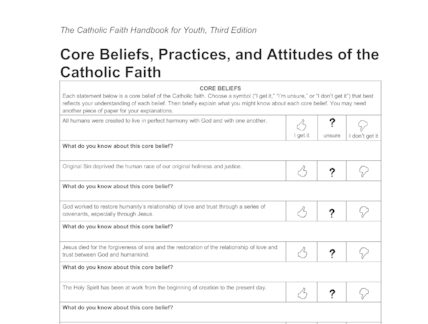
Each statement below is a core belief of the Catholic faith. Choose a symbol (“I get it,” “I’m unsure,” or “I don’t get it”) that best reflects your understanding of each belief. Then briefly explain what you might know about …
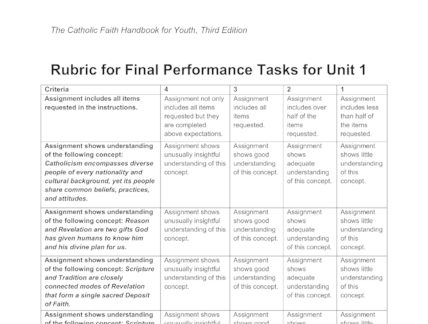
A rubric for the final performance tasks for Unit One about the basics of Catholicism, Scripture and Tradition, and Reason and Revelation. The options include reflecting on the Catholic faith in an essay, writing a personal story about your salvation …
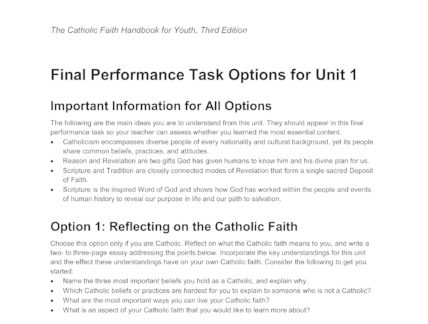
Options of final performance tasks for Unit One about the basics of Catholicism, Scripture and Tradition, and Reason and Revelation. The options include reflecting on the Catholic faith in an essay, writing a personal story about your salvation history, or …
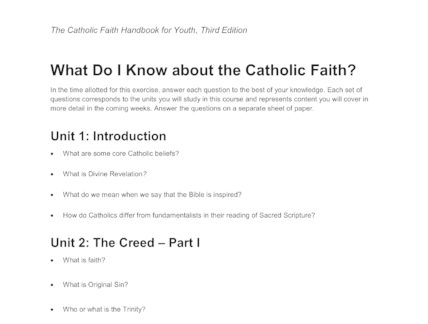
In the time allotted for this exercise, answer each question to the best of your knowledge. Each set of questions corresponds to the units you will study in this course and represents content you will cover in more detail in …
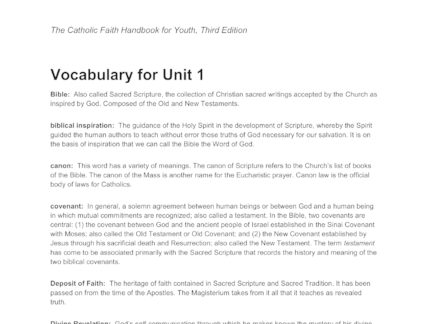
A list of vocabulary words for unit one, defines the terms Bible, biblical inspiration, canon, covenant, Deposit of Faith, Divine Revelation, Ecumenical Council, Gospel, inerrancy, Israelites, Law, Magisterium, natural revelation, New Testament, Old Testament, Parousia, reason, Sacred Scripture, Sacred Tradition, …
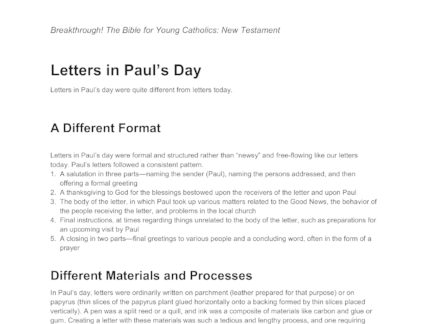
An article that discusses the format of Paul’s letters and how they are different from letters today.
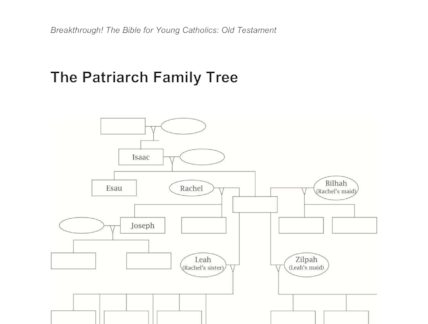
A fill in the blank family tree of several generations of people in the Old Testament.
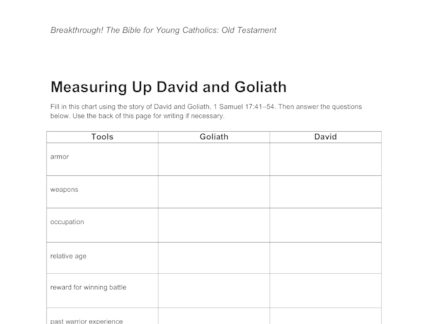
A worksheet where students fill in a chart using the story of David and Goliath as well as answering questions.
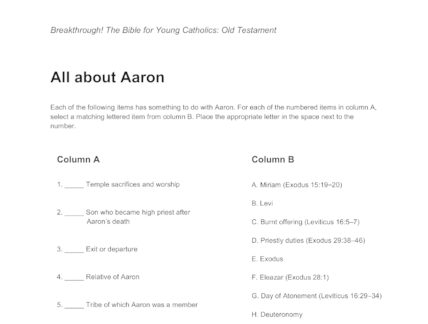
A matching worksheet about items and people that relate to Aaron in the Old Testament.
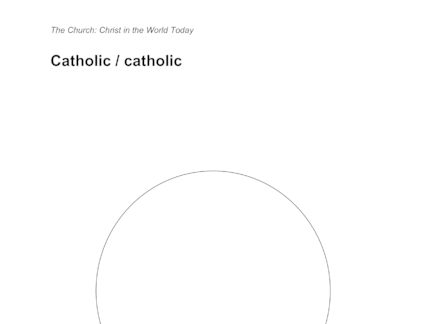
A worksheet that visually explores the differences between Catholic and catholic.
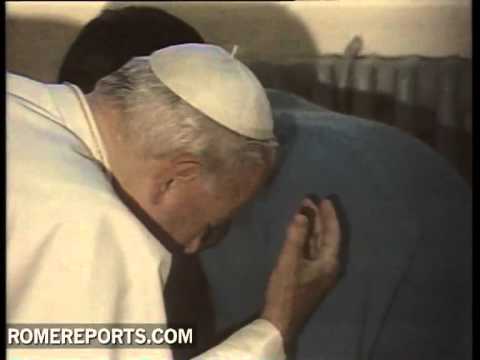
A video explaining the assassination attempt on Pope Saint John Paul II's life.
A short video on how the Church is good, even though there have been bad popes.
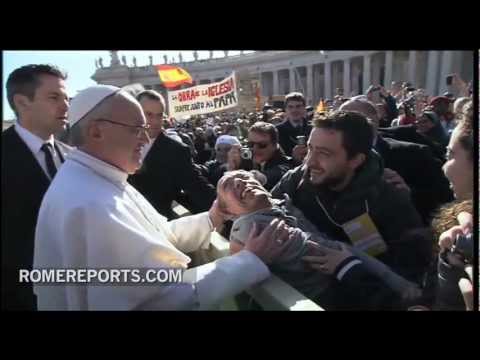
A video clip of Pope Francis stopping to bless a man with a disability.
A brief clip on the similarities and differences between Adam and Eve, and Jesus and the Blessed Virgin Mary.
A brief discussion on if excommunication condemns someone to Hell.
A short discussion on if non-Catholic Christians can receive Communion in the Catholic Church.
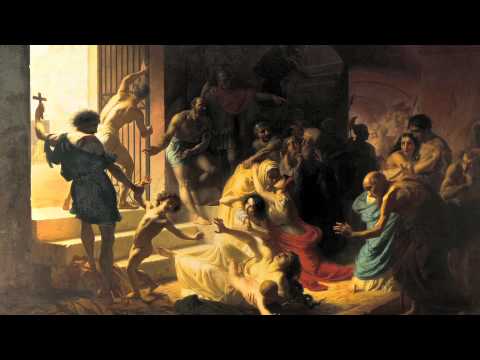
A short video segment on the early Church, and Emperor Constantine's role in it.
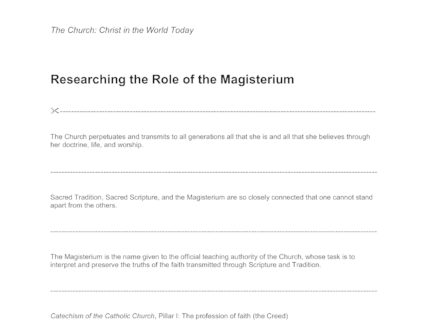
Several strips of paper that may come in handy when researching the role of the Magisterium.
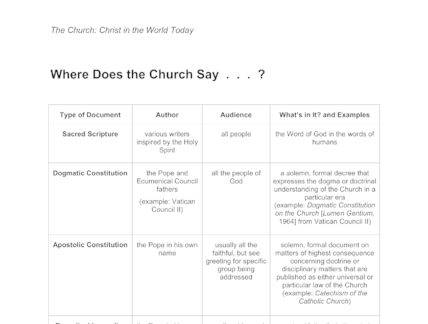
A chart outlining different types of Church documents, the author and audience of each particular document, and what’s in each document.
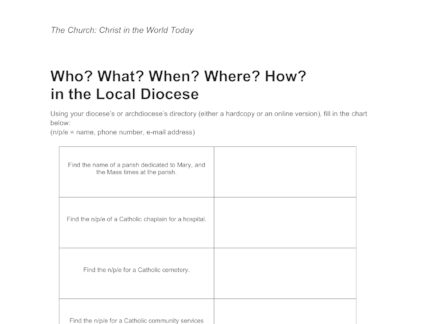
An activity where students are asked to locate information about their local diocese.
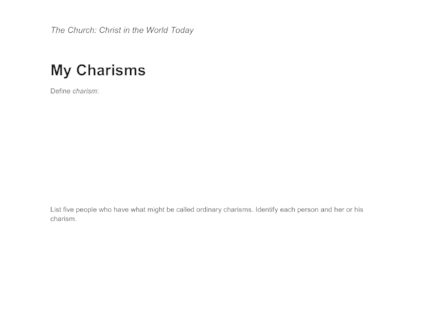
A worksheet where students are asked about ordinary charisms and religious charisms.
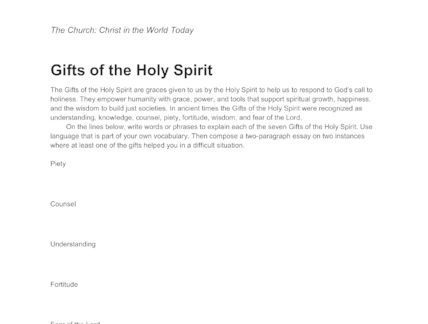
A worksheet where students are asked to explain each of the seven Gifts of the Holy Spirit and then compose a short essay on instances where the gifts helped them out in difficult situations.
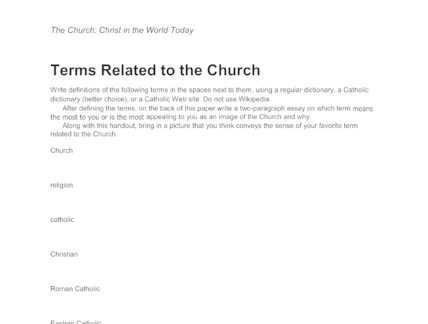
A worksheet where students are asked to define several vocabulary terms related to the Church and write a short essay on which term means the most to them.
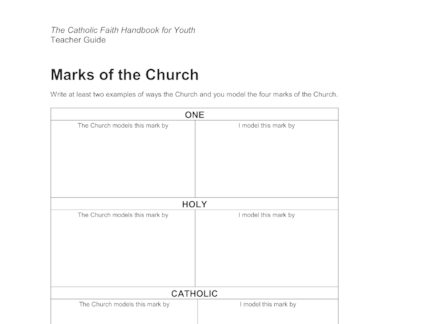
A chart that students are asked to fill in with at least two examples of ways the Church models the four marks of the Church, and at least two examples of ways they model the four marks of the Church.
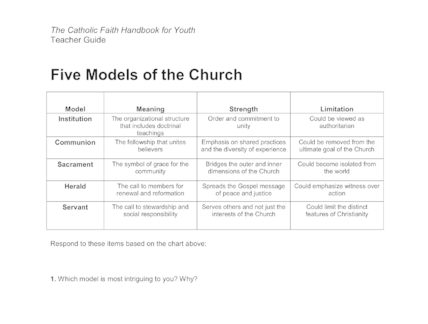
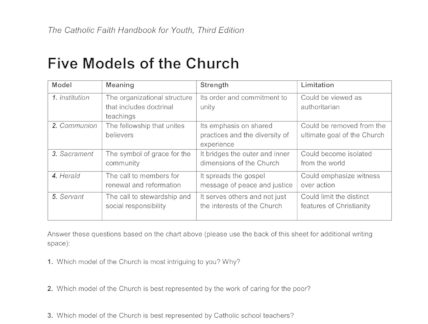
An activity where students are given a chart containing the meanings, strengths, and limitations of each of the five models of the Church and asked to answer related questions.
An article on the persecution of Christians in the Roman Empire.
An article on the events that took place at the Second Vatican Council.
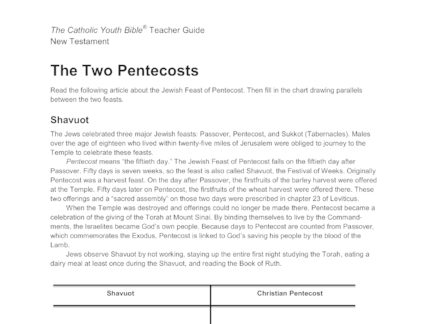
A chart used to draw parallels between the feasts of Shavuot and Christian Pentecost.

A documentary discussing the historical/theological precedents for celibacy.
Explains how priests were formed in the early stages of Christianity.

An explanation of the apocalypse as discussed in the book of Revelation.

A documentary explaining the events surrounding Jesus' arrest and trial.

A documentary discussing the early church, its members, and the means by which it expanded. Note: Viewing begins at 1:10.

A documentary discussing the integral and often contentious role of women, past and present, in the Catholic Church. Note: Viewing begins at 1:01.

A documentary chronicling the events of the Crusades and their lasting impact.

A cinematographically excellent documentary explaining in colloquial and relatable language the unexpectedly amicable relationship between science and Christianity.

A cinematographically excellent documentary explaining in colloquial and relatable language the history of the development of many Christian denominations.
This PowerPoint is part of the Living in Christ Series. It explains the difference between covenant and contract, reviews the 5 major covenants in the Old Testament, and discusses the New Covenant in Christ.
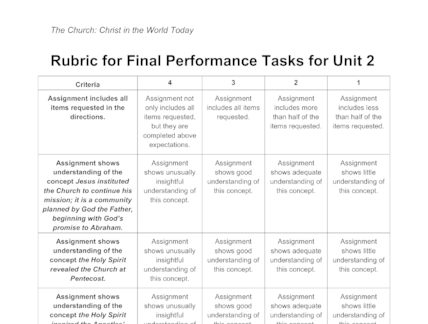
This rubric is part of the Living in Christ Series. It serves as a guide for assessing students on projects that communicate key ideas about the Catholic Church, especially its scriptural basis and origin.
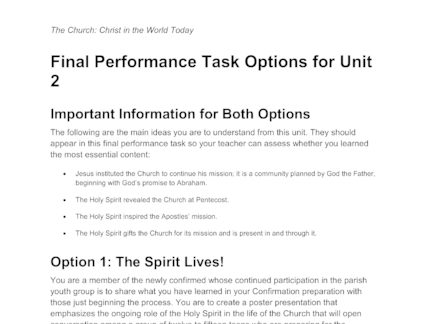
This resource is part of the Living in Christ Series. It offers ideas for assessing students who have recently learned about the Church, especially the birth of the Church at Pentecost.
https://www.newadvent.org/cathen/12272b.htm
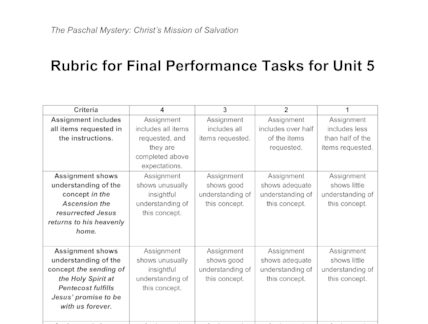
This rubric is part of the Living in Christ Series. It serves as a guide for assessing students on projects covering the main ideas of the Paschal Mystery, especially the institution of the Church and the Sacraments.
This resource is part of the Living in Christ Series. It offers various project ideas for students who have recently studied the Paschal Mystery, especially the birth of the Church at Pentecost, the descent of the Holy Spirit, and the …
This article is part of the Living in Christ Series. It offers an extensive overview of the political and religious structures and influences at work in Jesus' time.
This PowerPoint presentation is part of the Living in Christ Series. It explores salvation history, the transmission of Divine Revelation, and the role of the Magisterium.
This PowerPoint is part of the Living in Christ Series. It offers an overview of the Acts of the Apostles and the Pauline and non-Pauline letters of Saint Paul in the New Testament.
This PowerPoint is part of the Living in Christ Series. It introduces the development of the New Testament canon from Oral Tradition through translation.
This article is part of the Living in Christ Series. It discusses the Apostles and followers of Jesus who are known in Scripture, including Peter and Mary Magdalene, among others.
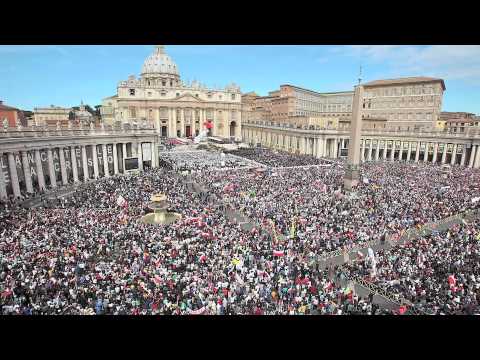
The Mass Is Changing...How? Why? And what does it all mean for you? Catholic Answers Senior Apologist Jimmy Akin explains why the Church has decided to issue a new translation of the Roman Missal.
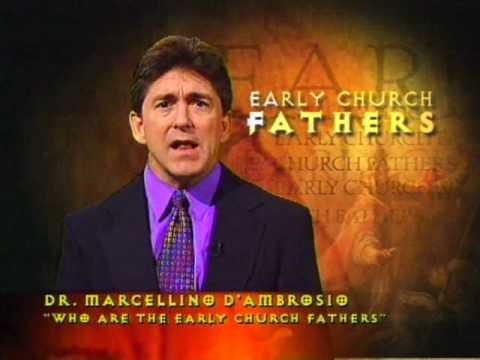
This video presents an explanation of who the Early Church Fathers were and what they did for the Church.
Much of the controversy about The Passion of the Christ centers around one question: Who killed Jesus? The Anti-Defamation League feels the movie lays the blame at the feet of the Jews. Mel Gibson, the movie's director, producer and cowriter, …
What is the pope? The pope is the bishop of the Church of Rome, Italy. Because of the importance of Rome, Tradition recognizes the pope as the supreme pastor of all Christians. Why is the Church of Rome so important? …
Ever since the church got involved in the wedding ceremony, relatively late in Christian history, it has stood by its main belief about a marriage. It’s the consent of the couple that binds. SEVENTH IN A 10-PART SERIES ON CHURCH …
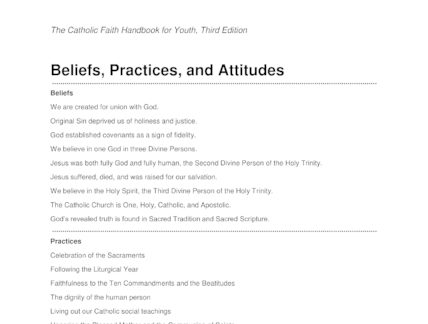
Catholicism is a remarkably rich religion, characterized by a complex tapestry of beliefs, practices, values, rituals, traditions, and more. When viewed "from the outside"--that is, by those who do not share its communal life--Catholicism is probably most frequently identified by …
Making the sign of the cross is a gesture that says, in shorthand, that a person is a Catholic. It appears as an icon in popular culture, and as a gesture it is scattered throughout film history, for example: movie …
I was a high school junior before I learned that the Catholic faith was something more than Mass, folk songs and the Bible. Father Corry turned me on to Church history in his religion class. He showed me how our …
The Catholic Church's attitude toward biblical study has undergone a sea of change in recent times. A world-renowned Scripture scholar explains why and how. Very often when older Catholics hear at Mass a presentation about the Bible they are puzzled. …
“WHAT IS THE BEST TRANSLATION OF THE BIBLE?” This is the question that people who teach biblical studies hear more than any other. A bewildering abundance of alternatives is available to those who want to begin reading the Bible. This …
I always thought that I would have made a great archbishop in Salzburg during the time of Mozart. But instead I'm the archbishop of Milwaukee in the time of rock 'n' roll. That's the way life turns out. We live …
Central Characteristics of Roman Catholicism Catholicism is a remarkably rich religion, characterized by a complex tapestry of beliefs, practices, values, rituals, traditions, and more. When viewed “from the outside”—that is, by those who do not share its communal life—Catholicism is …
Session Overview: This 2-hour session is designed to use role-playing skills for a presentation to an audience. Scripture: This session is based on Luke 2:1-20. Read the Scripture passage to the young people after the role-play, "Christmas Legend," has been …
Editor's note: The author of our feature article, Kathleen Hodapp, was one of the participants in last summer's workshop "The Catholic High School As Faith Community," held here in Winona, Minnesota, as well as on the East Coast and the …
As we are all aware, 1992 marks the quincentenary of Christopher Columbus's landing in the West Indies–thus, the "discovery" of America. For religious educators, this anniversary offers an opportunity to examine the injustices done to Native Americans by the colonizers …
In teaching church history, I have used, with some degree of success, the approach of showing links between the events and issues of the past and the concerns the church is facing today and will be facing in the future. …
Course materials, such as the high school religion textbooks and teacher's manuals published by Saint Mary's Press, are a significant ingredient in the education of our young people. But we all know that the most important factor in a student's …
For a couple of years, Saint Mary’s Press sponsored a listserv discussion group online. Discussions on a variety of topics were pursued via e-mail. In this section of the web site, I summarize some of the highlights from these old …
Copyright © 2025 Saint Mary's Press. All rights reserved. • Privacy Policy