Avoiding Arrogance While Evangelizing
A video on how to share the truth of the faith.
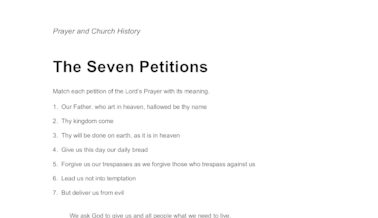
On this handout, students match the meaning to each line of the Lord’s Prayer.


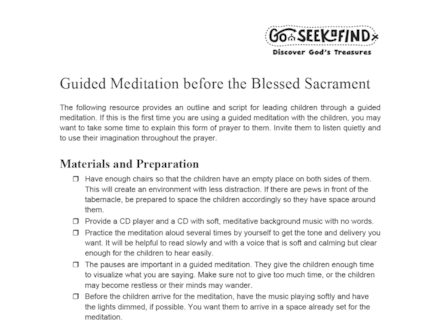
An outline and script for a guided meditation before the Blessed Sacrament in the tabernacle. Have you explored Go Seek Find: Discover God’s Treasures yet? This one-of-a-kind sacrament prep program will help children discover how preparing for the sacraments is …


The video "Jesus Urging His Disciples to Stay Awake," by Turnback to God, available on YouTube (5:32), is an animated account of Jesus at prayer in Gethsemane (an amalgamation of Gospel accounts). It is best used on day 4.
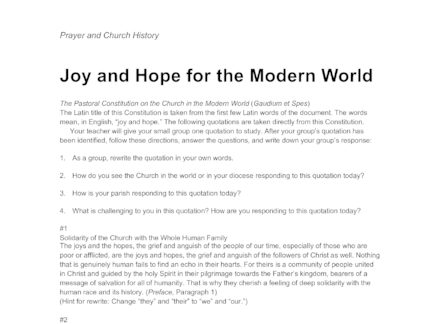
This handout provides questions for students to reflect on and answer as they read quotations from this Constitution.
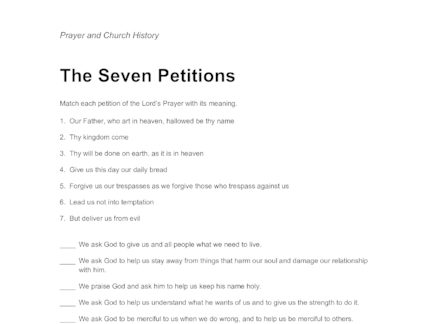
On this handout, students match the meaning to each line of the Lord’s Prayer.
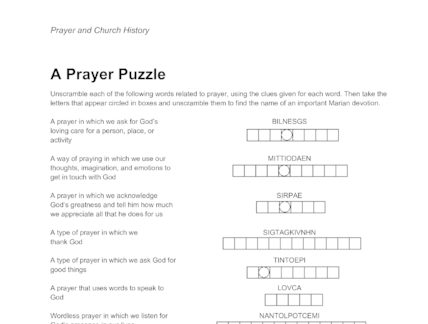
On this handout, students must use clues to unscramble words related to prayer.
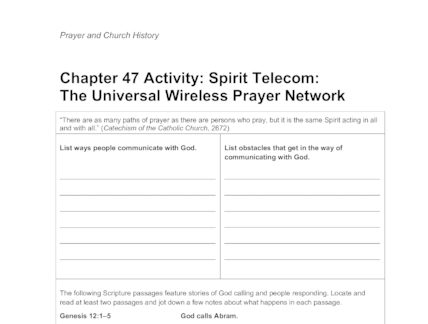
This handout guides students as they locate and read various Scripture passages focusing on the many way God calls us to prayer.
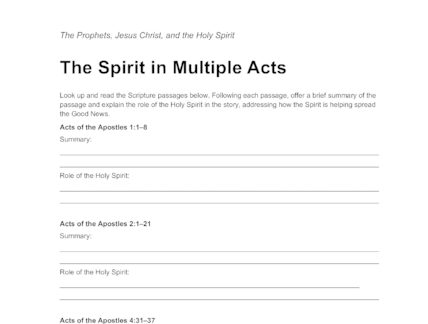
Students look up and read several passages that the Holy Spirit. The worksheet asks students to summarize each passage and describe the role of the Holy Spirit in spreading the Good News.
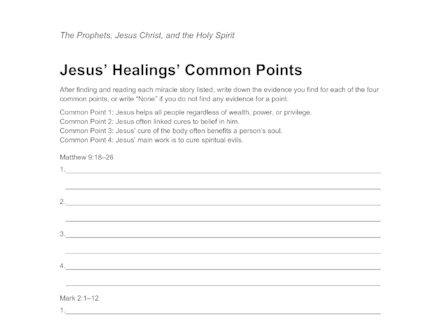
Students look up and read several miracle stories from the New Testament before identifying common points between them.
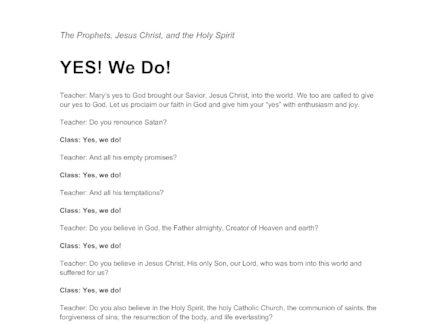
This handout helps provides the dialogue for the students to renew their baptismal promises as a class.
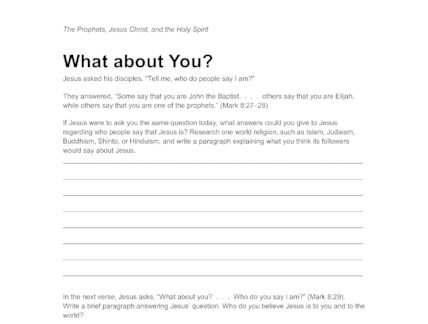
After reading Mark 8:27-29, students must answer several questions about who Jesus is to today’s world and people.
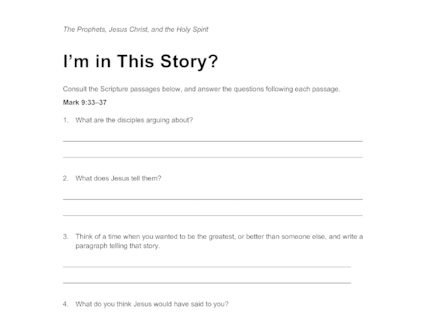
Students must look up several Scripture passages that give insight into the disciples of Jesus. This worksheet poses questions that help make Jesus’ mission relatable to students.

The song/video "Burning in My Soul," by Matt Maher, available on YouTube (3:45), provides a nice connection to Pentecost and the modern listener and is appropriate for use on day 4.
The song/video "Forever (Live)," by Kari Jobe, available on YouTube (6:50) with lyrics, is a good opening prayer for day 4. The video can be shortened to 4:38.

The video "Resurrection Cartoon," available on YouTube (3:05), offers a fun portrayal of the Resurrection and is appropriate for use on day 1.

The video "The Prodigal," by The Skit Guys, available on YouTube (7:27), is an engaging retelling of the Lost Son story for the day 3 lesson.

The song/video "Call It Grace," by Unspoken, available on YouTube (4:00), is appropriate for use on day 3.

The song/video "Holy, Holy, Holy," by Steven Curtis Chapman, available on YouTube (4:54), is a contemporary version of the classic hymn and can be used for prayer or meditation on day 2.

The video "Matthew 1:1–16: The Genealogy of Jesus Christ," available on YouTube (2:19), is an animation of the lineage of Jesus that shows his connection to the tribe of Judah (see 0:18). It is used on day 3.

The video “Samson: The Final Judge,” by Meaningful Jewish Screentime, available on YouTube (6:57), is an entertaining, animated version of the story of Samson. It is appropriate for use on day 4.
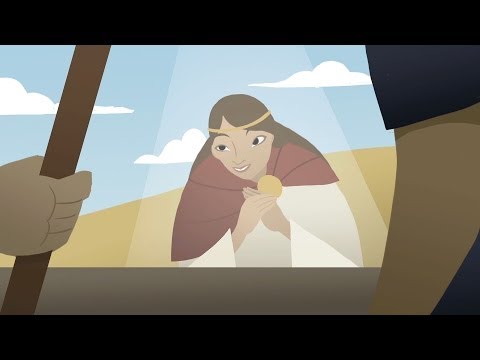
The video “Deborah’s Army: The Book of Judges,” by Meaningful Jewish Screentime, available on YouTube (3:02), is an entertaining, animated version of Judges, chapter 4. It is appropriate for use on day 3.
The song/video “We Delight,” by Caedmon’s Call, available on YouTube (3:27), is a praise song about God’s Law. It is appropriate for use on any of the days.
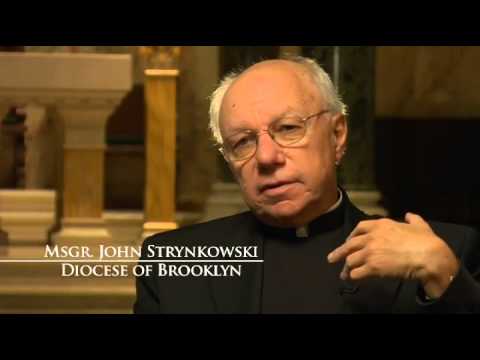
The video “Mysteries: The Trinity,” available on YouTube (22:57), presented by several Catholic priests and theologians, would be good preparation for teaching this chapter.

The video “The Trinity (Christian Triune Godhead) Explained Part 1,” available on YouTube (3:55), is a good introduction to the Trinity, but it might be challenging for some young adolescents. There is also a part 2 that explains some common …
The video “The Trinity (Christian Triune Godhead) Explained Part 1,” available on YouTube (3:55), is a good introduction to the Trinity, but it might be challenging for some young adolescents. There is also a part 2 that explains some common …

The song/video “How Great Is Our God,” by Chris Tomlin, available on YouTube (4:27) with lyrics, is a contemporary song that gives praise to God as Father, Son, and Holy Spirit. It would be a nice introduction to God’s greatness …
This PowerPoint accompanies Chapter E by giving a summary of the stories of Rebecca, Ruth, Judith, and Esther.
This PowerPoint accompanies Chapter C by giving a summary of the stories of Joshua, Deborah, and Samson.
This PowerPoint accompanies Chapter B by giving a summary of the story of Moses and the Exodus.
This PowerPoint accompanies Chapter 7 by exploring what it means to be human.
This PowerPoint accompanies Chapter 6 by exploring creation and the existence of evil.
This PowerPoint accompanies Chapter 4 by exploring the central mystery of the Catholic faith: the Trinity.
This PowerPoint follows along with the concepts presented in Chapter 3 of The Old Testament and the Trinity.
This PowerPoint follows along with the concepts presented in Chapter 2 of The Old Testament and the Trinity.
This PowerPoint follows along with the concepts presented in Chapter 1 of The Old Testament and the Trinity.
This worksheet helps students to reflect on the numerous images of the lamb found in Scripture.
This handout breaks down the Nicene Creed line-by-line and gives each a brief explanation and commentary.
A lesson plan for lesson 14 in The Catholic Faith Handbook for Youth: Catechist Guide.
A lesson plan for lesson 13 in The Catholic Faith Handbook for Youth: Catechist Guide.
A lesson plan for lesson 12 in The Catholic Faith Handbook for Youth: Catechist Guide.
A lesson plan for lesson 11 in The Catholic Faith Handbook for Youth: Catechist Guide.
A lesson plan for lesson 10 in The Catholic Faith Handbook for Youth: Catechist Guide.
A lesson plan for lesson 9 in The Catholic Faith Handbook for Youth: Catechist Guide.
A lesson plan for lesson 8 in The Catholic Faith Handbook for Youth: Catechist Guide.
A lesson plan for lesson 6 in the Catholic Faith Handbook for Youth: Catechist Guide.
A lesson plan for lesson 5 in The Catholic Faith Handbook for Youth: Catechist Guide.
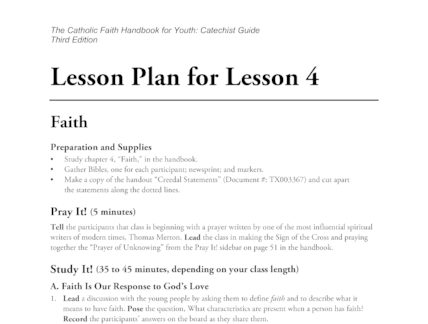
A lesson plan for lesson 4 in The Catholic Faith Handbook for Youth: Catechist Guide.
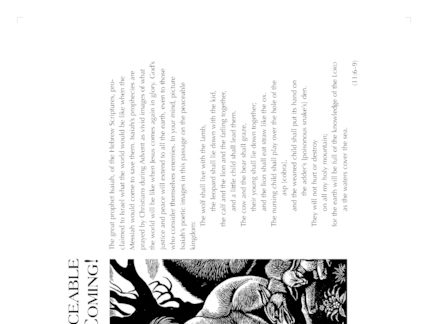
This handout offers a brief look at the use of Isaiah’s visions of the kingdom during Advent.
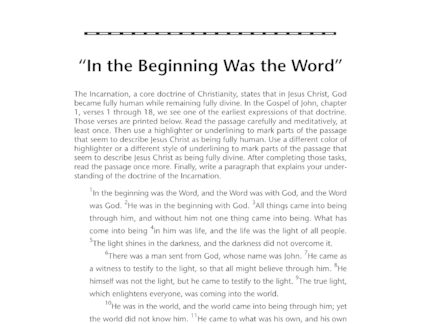
The Incarnation, a core doctrine of Christianity, states that in Jesus Christ, God became fully human while remaining fully divine. In the Gospel of John, chapter 1, verses 1 through 18, we see one of the earliest expressions of that …
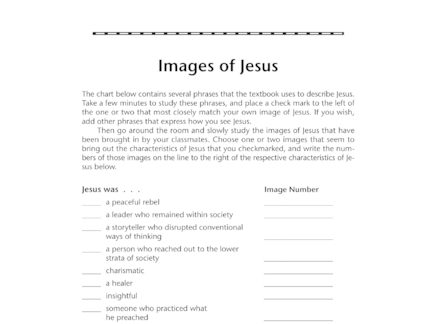
The chart below contains several phrases that the textbook uses to describe Jesus. Take a few minutes to study these phrases, and place a check mark to the left of the one or two that most closely match your own …
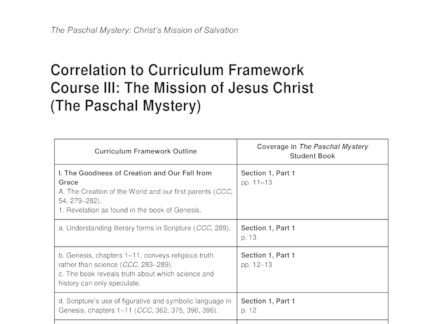
Correlation to Curriculum Framework Course III: The Mission of Jesus Christ (The Paschal Mystery) from The Paschal Mystery: Christ’s Mission of Salvation.
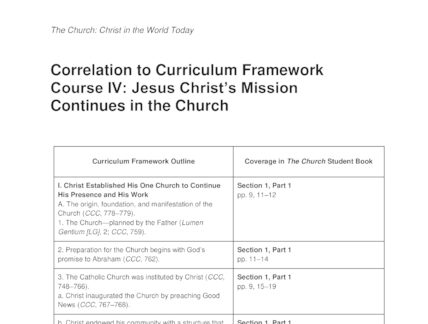
Correlation to Curriculum Framework Course IV: Jesus Christ’s Mission Continues in the Church from The Church: Christ in the World Today.
A personal reflection on how Jesus’ life, death, resurrection, and ascension save us from sin and death and bring us to new life in him.
A personal story about turning to Jesus for help and loving others unconditionally, just as Jesus loves us.
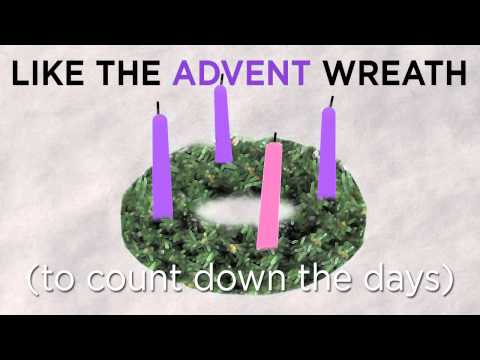
A quick, two-minute video from Busted Halo that explains why we celebrate Advent and wait to celebrate Christmas.
This two-minute video from Busted Halo describes the final week of Lent that we spend preparing for Easter.
A summary of Chapter 24, End Things: Heaven and Hell from the Catholic Connections Handbook for Middle Schoolers, Second Edition.
One of the symbols the Church uses to represent Christ’s Resurrection is the lily. This beautiful white flower comes to life in the spring, reborn from a lifeless bulb. It resembles a trumpet, an instrument used to announce important news, …
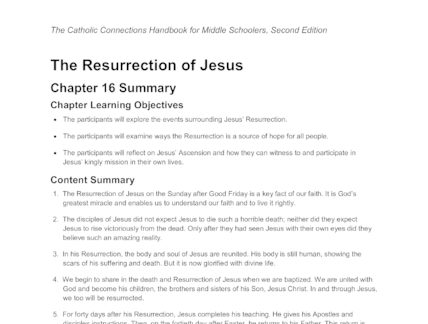
A summary of Chapter 16, The Resurrection of Jesus from the Catholic Connections Handbook for Middle Schoolers, Second Edition.
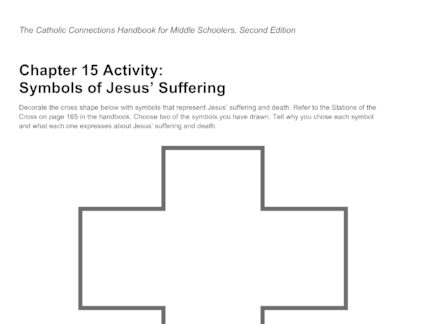
Decorate the cross shape below with symbols that represent Jesus’ suffering and death. Refer to the Stations of the Cross on page 165 in the handbook. Choose two of the symbols you have drawn. Tell why you chose each symbol …
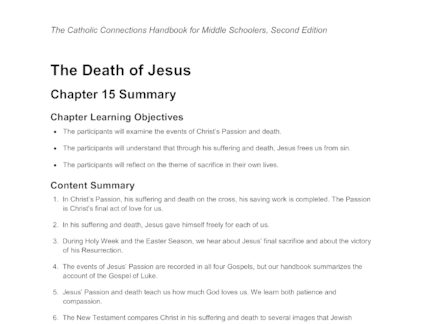
A summary of Chapter 15, The Death of Jesus from the Catholic Connections Handbook for Middle Schoolers, Second Edition.
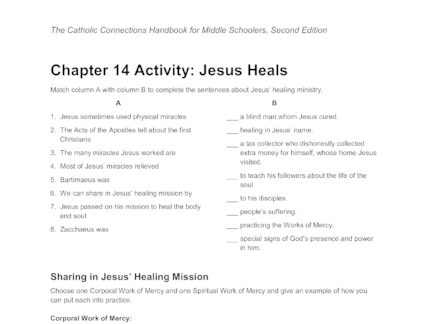
Match column A with column B to complete the sentences about Jesus’ healing ministry.
A summary of Chapter 14, Jesus Heals from the Catholic Connections Handbook for Middle Schoolers, Second Edition.
A summary of Chapter 13, Jesus Teaches from the Catholic Connections Handbook for Middle Schoolers, Second Edition.
A summary of Chapter 12, The Birth of Jesus from the Catholic Connections Handbook for Middle Schoolers, Second Edition.
Recall times when you received unexpected good news, either of an everyday nature—such as getting a better grade than you expected on a test—or on a far bigger, perhaps life-changing, scale. Describe an example of each of these types of …
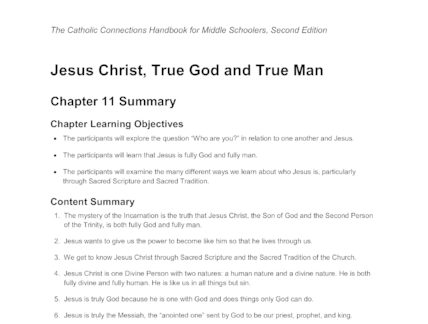
A summary of Chapter 11, Jesus Christ, True God and True Man from the Catholic Connections Handbook for Middle Schoolers, Second Edition.
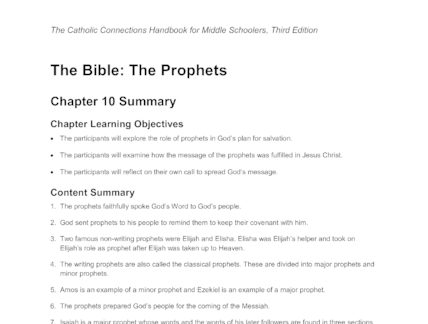
A summary of Chapter 10, The Bible: The Prophets from the Catholic Connections Handbook for Middle Schoolers, Second Edition.
A personal story about being intentional about our Christian discipleship.
A personal story about the mission of the Church to share the good news of salvation with others.
A PowerPoint on The Catholic Faith Handbook for Youth, Third Edition Chapter 11, Jesus’ Resurrection.
A PowerPoint on The Catholic Faith Handbook for Youth, Third Edition Chapter 10, Jesus’ Death.
A PowerPoint on The Catholic Faith Handbook for Youth, Third Edition Chapter 9, Jesus’ Message and Mission.
A PowerPoint on The Catholic Faith Handbook for Youth, Third Edition Chapter 8, Jesus Christ: True God and True Man.
A PowerPoint on The Catholic Faith Handbook for Youth, Third Edition Chapter 7, The Promise of a Messiah.
A PowerPoint on The Catholic Faith Handbook for Youth, Third Edition Chapter 5, God Our Father.
A PowerPoint on The Catholic Faith Handbook for Youth, Third Edition Chapter 2, Knowing God: Reason and Revelation.
Activities for Chapter 11 Jesus’ Resurrection, including a core activity, core activity extension, and additional activities.
Activities for Chapter 10 Jesus’ Death, including a core activity, core activity extension, and additional activities.

Activities for Chapter 9 Jesus’ Message and Mission, including a core activity, core activity extension, and additional activities.
Activities for Chapter 8 Jesus Christ: True God and True Man, including a core activity, core activity extension, and additional activities.
Read the passage listed under “Forgiveness and Salvation,” and then read your assigned passages from Matthew, Mark and John, or Luke, and answer the questions as your teacher has directed, either in writing (on a separate sheet of paper) or …
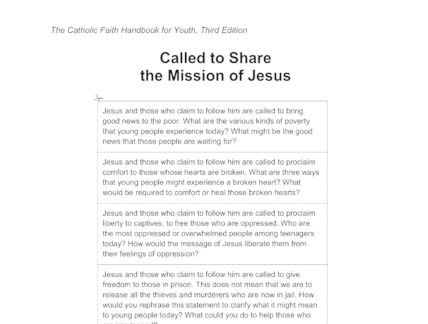
Questions about how we can imitate Jesus’ example in the way we interact with others.
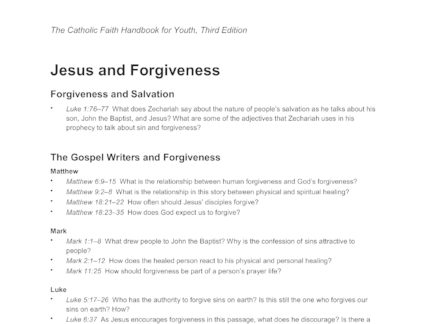
Questions about Scripture verses that talk about forgiveness and salvation.

The lesson learning objectives and content summary for Lesson 11, Jesus’ Resurrection.
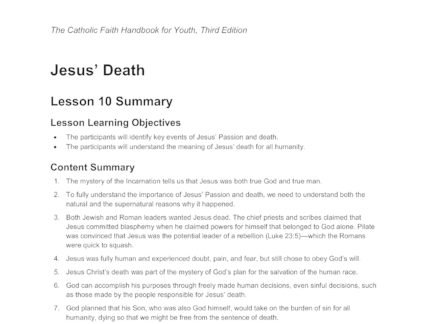
The lesson learning objectives and content summary for Lesson 10, Jesus’ Death.
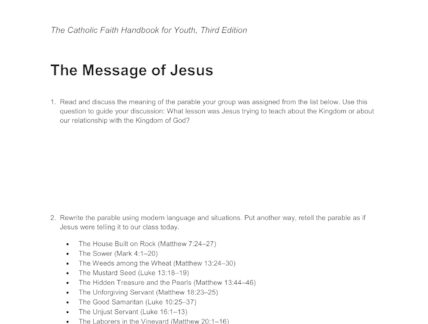
Read and discuss the meaning of the parable your group was assigned from the list below. Use this question to guide your discussion: What lesson was Jesus trying to teach about the Kingdom or about our relationship with the Kingdom …
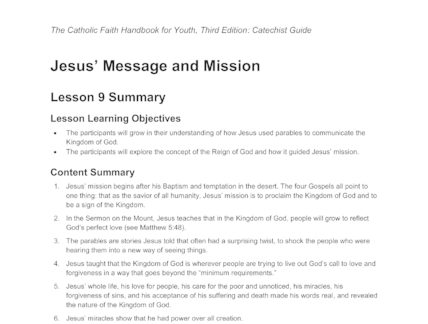
The lesson learning objectives and content summary for Lesson 9, Jesus’ Message and Mission.
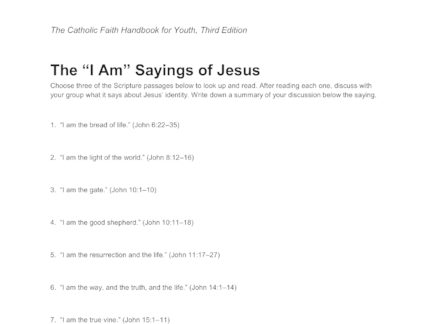
Choose three of the Scripture passages below to look up and read. After reading each one, discuss with your group what it says about Jesus’ identity. Write down a summary of your discussion below the saying.
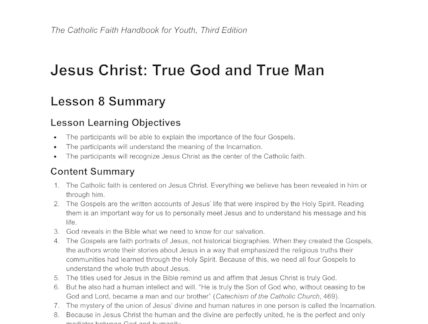
The lesson learning objectives and content summary for Lesson 8, Jesus Christ: True God and True Man.
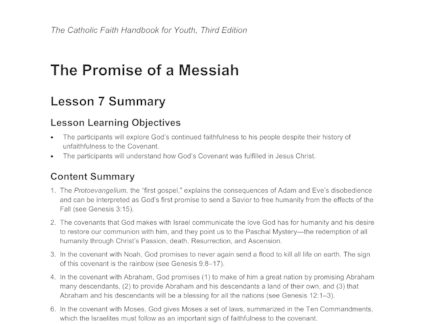
The lesson learning objectives and content summary for Lesson 7, The Promise of a Messiah.
The lesson learning objectives and content summary for Lesson 5, God our Father.
The lesson learning objectives and content summary for Lesson 3, The Bible’s Big Picture.
The lesson learning objectives and content summary for Lesson 2, Knowing God: Reason and Revelation.
Questions about Bible passages where Jesus teaches how to live.
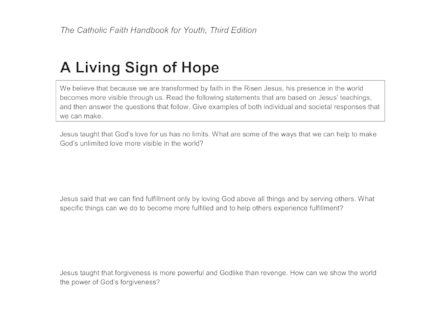
We believe that because we are transformed by faith in the Risen Jesus, his presence in the world becomes more visible through us. Read the following statements that are based on Jesus’ teachings, and then answer the questions that follow. …
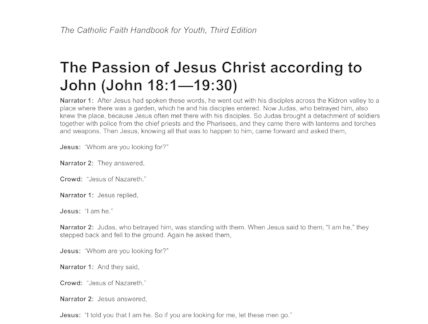
The narrative of Jesus’ passion according to the Gospel of John.
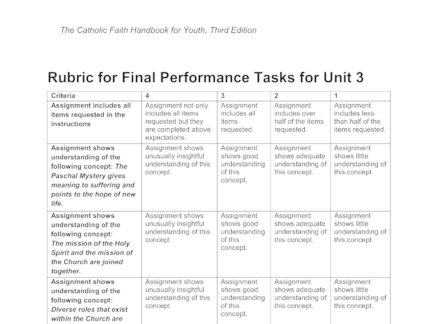
A rubric for the final performance task options for Unit 3 focusing on the Paschal Mystery, the Holy Spirit and the Church, and the mission of the Church. The options include exploring one important ministry in a diverse Church, creating …
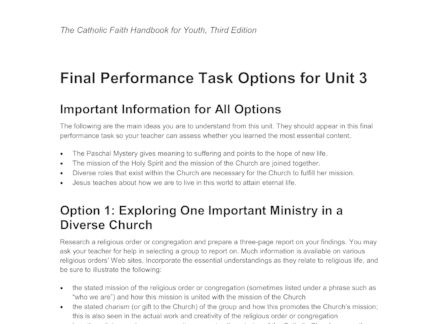
The final performance task options for Unit 3 focusing on the Paschal Mystery, the Holy Spirit and the Church, and the mission of the Church. The options include exploring one important ministry in a diverse Church, creating a poster comparing …
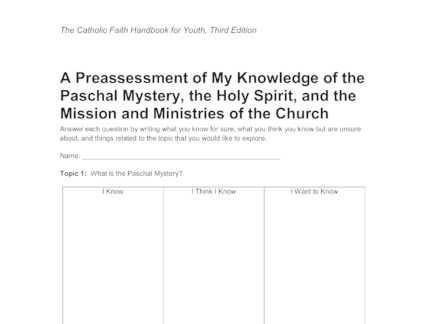
Answer each question by writing what you know for sure, what you think you know but are unsure about, and things related to the topic that you would like to explore.
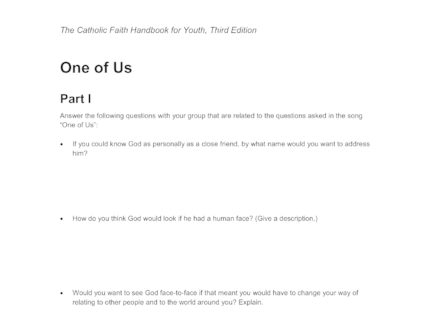
Answer the following questions with your group that are related to the questions asked in the song “One of Us”. Your instructor will lead you through Part II. Use the following questions as prompts for taking notes in your notebook.
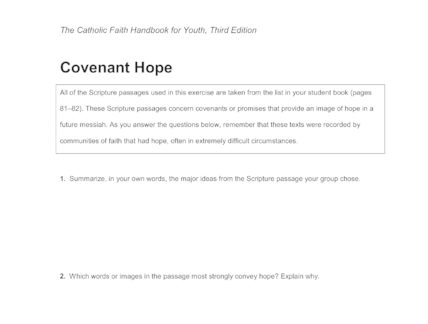
All of the Scripture passages used in this exercise are taken from the list in your student book (pages 81–82). These Scripture passages concern covenants or promises that provide an image of hope in a future messiah. As you answer …
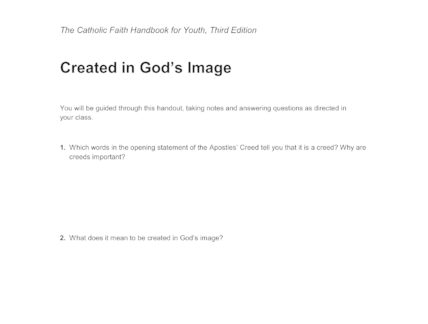
You will be guided through this handout, taking notes and answering questions as directed in your class.
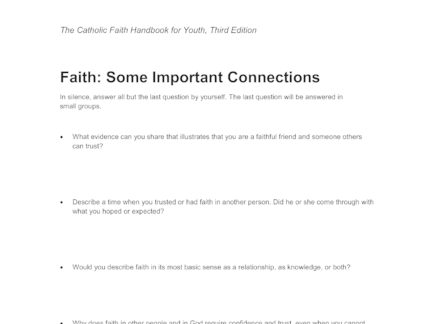
In silence, answer all but the last question by yourself. The last question will be answered in small groups.
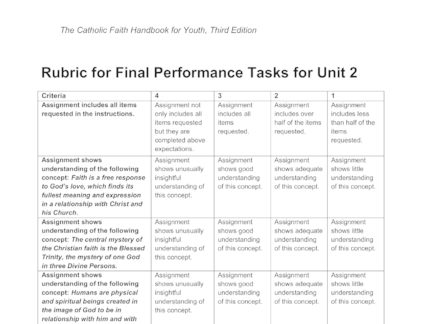
Rubric for grading the final performance tasks for Unit 2 focusing on faith, the Trinity, the Kingdom of God, and creation in the image of God. The options include writing a personal creed, creating a Holy Trinity play, or exploring …
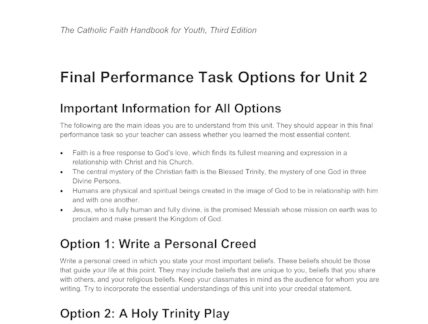
Options of final performance tasks for Unit 2 focusing on faith, the Trinity, the Kingdom of God, and creation in the image of God. The options include writing a personal creed, creating a Holy Trinity play, or exploring three Kingdom …
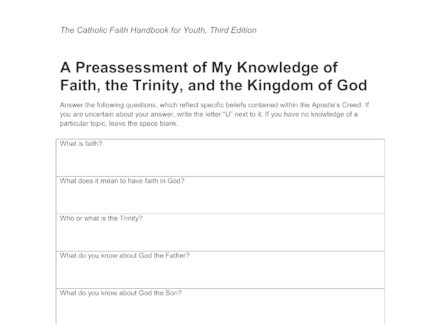
Answer the following questions, which reflect specific beliefs contained within the Apostle’s Creed. If you are uncertain about your answer, write the letter “U” next to it. If you have no knowledge of a particular topic, leave the space blank.
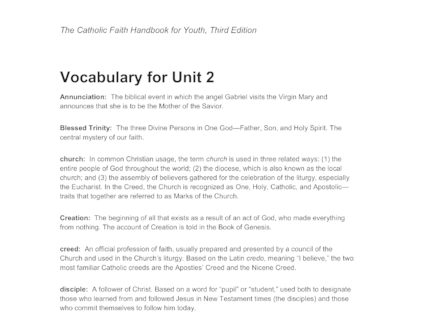
A list of vocabulary words for Unit 2 including Annunciation, Blessed Trinity, church, Creation, creed, disciple, ecumenism, evangelist, faith, Gospel, Incarnation, Kingdom of God, Messiah, ministry, Original Sin, parable, Paschal Mystery, salvation, stewardship, and Theotokos.
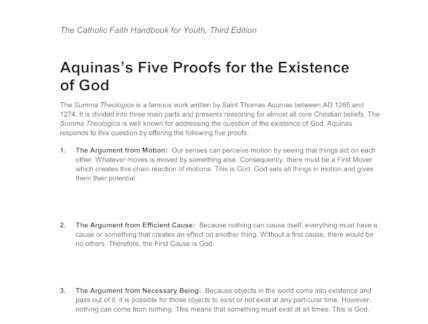
The Summa Theologica is a famous work written by Saint Thomas Aquinas between AD 1265 and 1274. It is divided into three main parts and presents reasoning for almost all core Christian beliefs. The Summa Theologica is well known for …
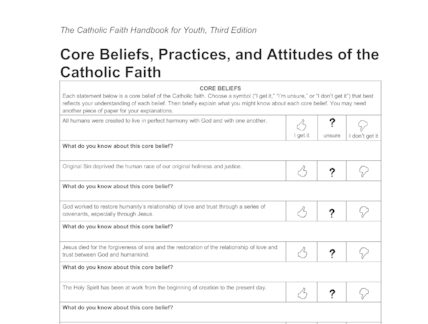
Each statement below is a core belief of the Catholic faith. Choose a symbol (“I get it,” “I’m unsure,” or “I don’t get it”) that best reflects your understanding of each belief. Then briefly explain what you might know about …
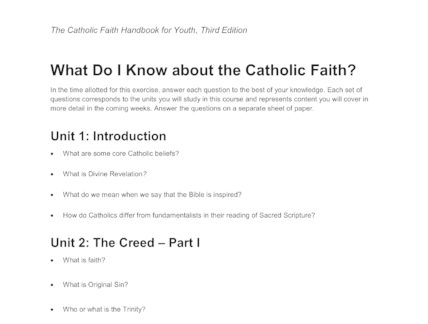
In the time allotted for this exercise, answer each question to the best of your knowledge. Each set of questions corresponds to the units you will study in this course and represents content you will cover in more detail in …
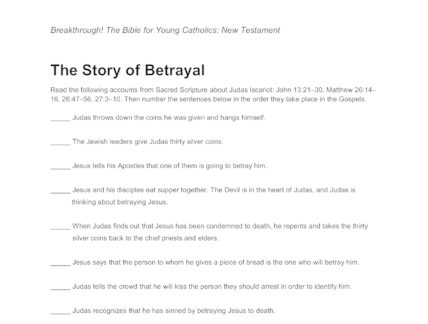
Read the following accounts from Sacred Scripture about Judas Iscariot: John 13:21–30, Matthew 26:14–16, 26:47–56, 27:3–10. Then number the sentences below in the order they take place in the Gospels.
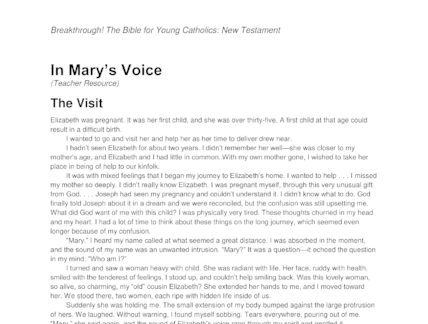
A reading that tells the story of Mary’s relationship with Jesus through her perspective.
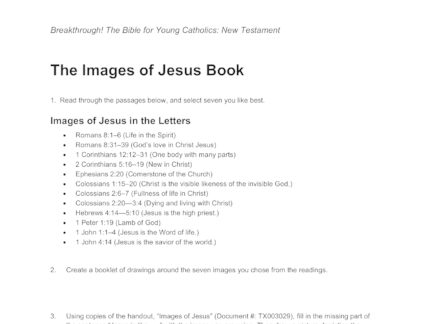
Read through the passages below, and select seven you like best. Create a booklet of drawings around the seven images you chose from the readings. Using copies of the handout, “Images of Jesus” (Document #: TX003029), fill in the missing …
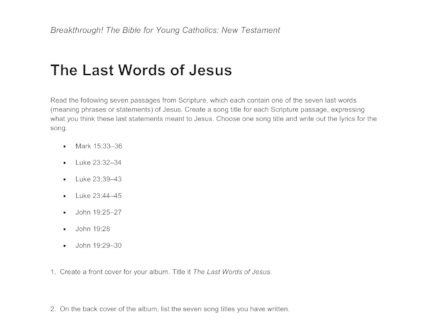
Read the following seven passages from Scripture, which each contain one of the seven last words (meaning phrases or statements) of Jesus. Create a song title for each Scripture passage, expressing what you think these last statements meant to Jesus. …
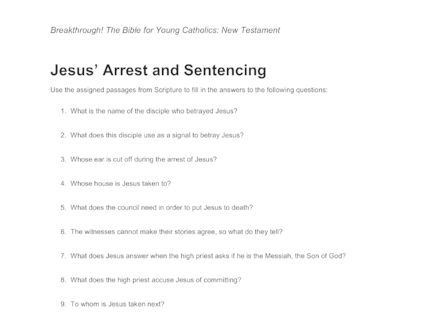
Use the assigned passages from Scripture to fill in the answers to the following questions.
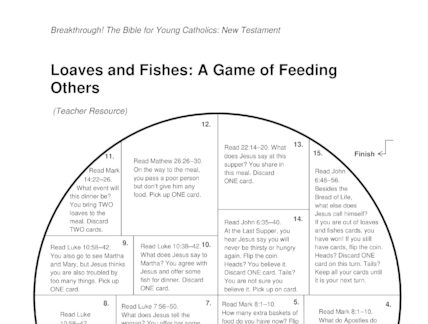
A game that involves reading Scripture passages, answering questions, and making your way through a maze.
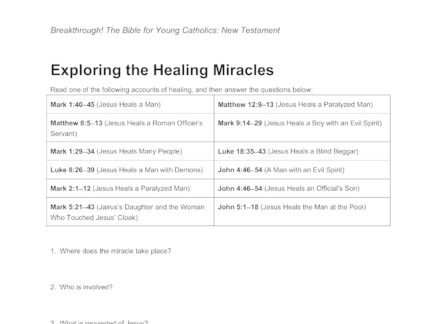
Read one of the following accounts of healing, and then answer the questions below.
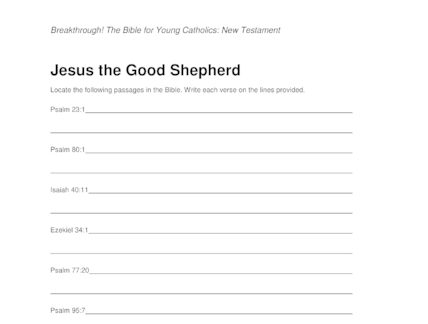
Locate the following passages in the Bible. Write each verse on the lines provided.
Read the Gospel passages below, and write a summary statement or two about what Jesus tells us about prayer.
A fill in the blank worksheet from the birth narrative of Jesus in the Gospel of Luke.
A short video on how Jesus' thirst on the cross was in accordance with the Scriptures.
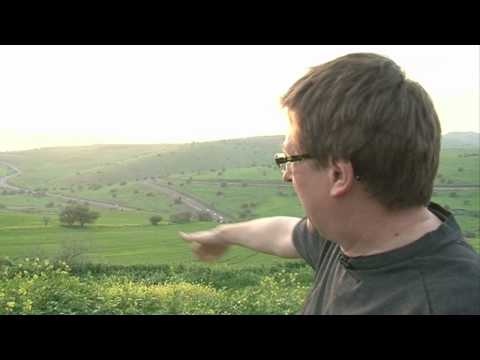
A short video that takes a look at how Jesus may have delivered his sermon on the mount.
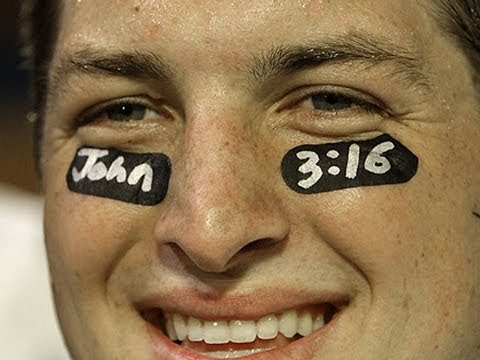
A short explanation of John 3:16, discussing justification by faith versus salvation as a gift.
A brief explanation of God's presence, or lack thereof, in Purgatory and Hell.
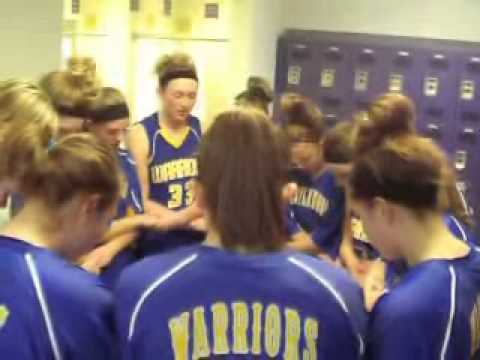
A video that explains the meaning and importance of the Lord's Prayer, and shows interviews with teen athletes who pray the Lord's Prayer as a team before sports games.
Sr. Helen Prejean discusses the violence of capital punishment.
A short video on how new discoveries in science are pointing to God.

A short video on why you shouldn't just say the Creed, you should pray the Creed.

A short video on the Catholic understanding of Jesus Christ.
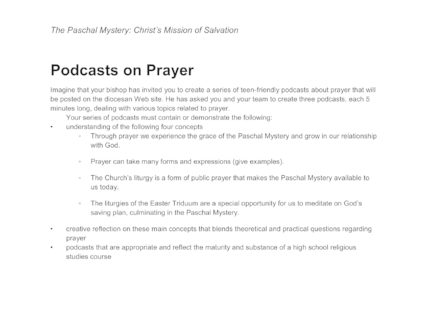
A worksheet where students are asked to create a series of teen-friendly podcasts about prayer.
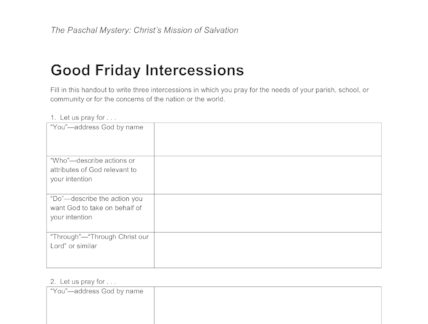
A handout that guides students through writing their own Good Friday intercessions.
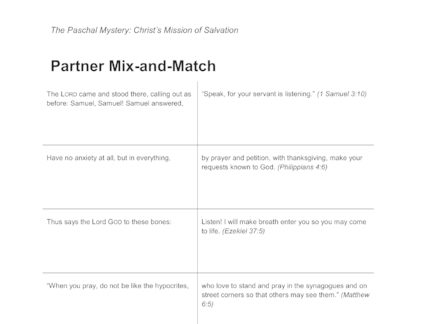
An activity where students work with a partner to complete Scripture passages.
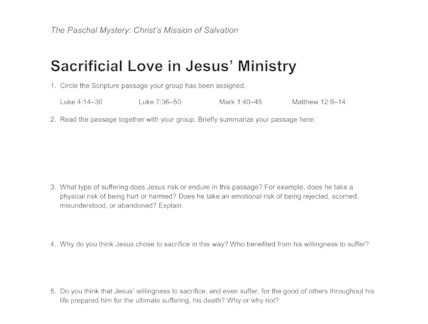
A worksheet where students are asked to read a Scripture passage, identify the type of suffering that Jesus risks or endures, and answer several questions regarding sacrifice and suffering.
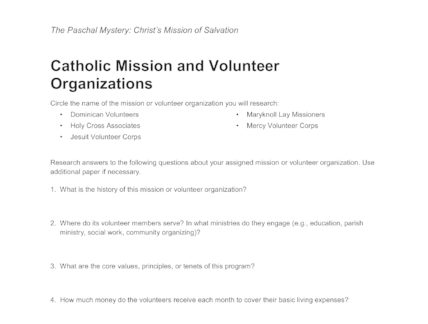
A worksheet where students are asked to research a mission or volunteer organization and answer several questions about their findings.
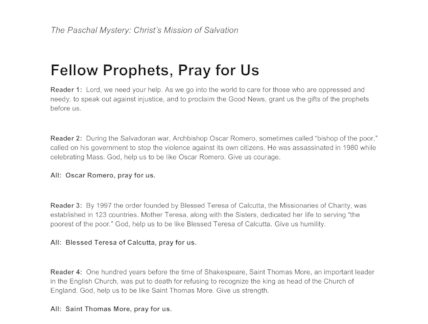
A short prayer service asking the Lord to grant us the gifts of the prophets before us.
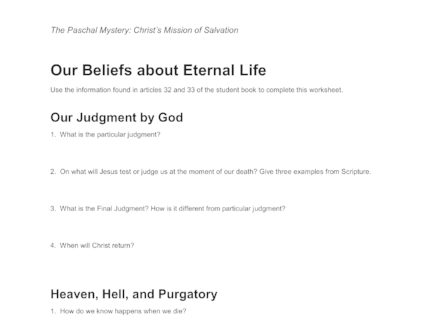
Use the information found in articles 32 and 33 of the student book to complete this worksheet.
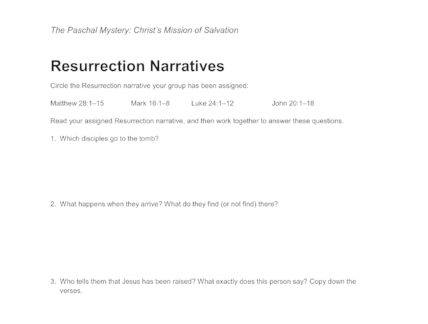
An activity where students are asked to work in groups to answer questions about the Resurrection narratives.
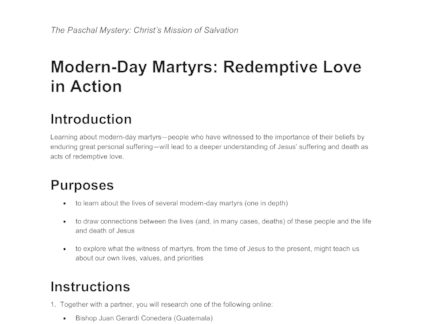
An activity where students will learn about the lives of several modern-day martyrs, draw connections between the lives of these people and the life and death of Jesus, and explore what the witness of martyrs, from the time of Jesus …
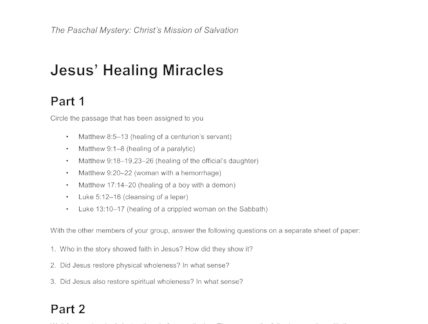
A worksheet where students are asked to look at Scripture passages that focus on Jesus’ healing miracles.
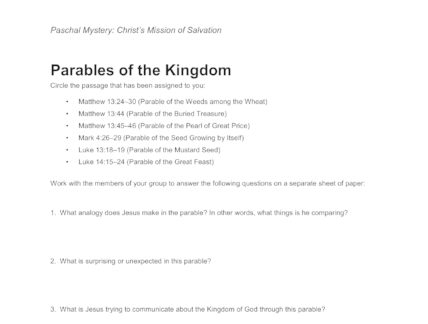
An assignment that looks at what Jesus is trying to communicate about the Kingdom of God through parables.
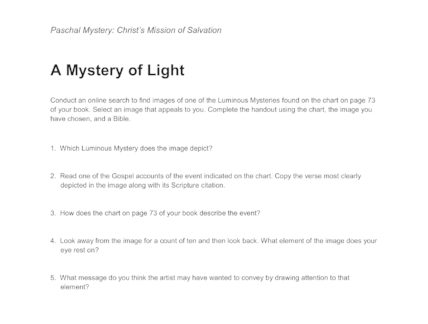
An assignment that asks students to conduct an online search to find images of one of the Luminous Mysteries found on the chart in their textbooks.
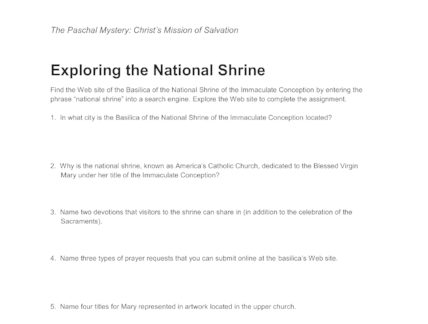
A worksheet asking students to discover more about the Basilica of the National Shrine of the Immaculate Conception by visiting their website.
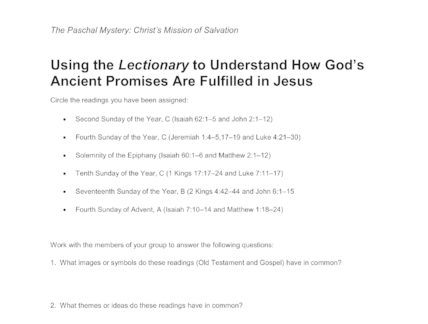
An activity that uses the Lectionary to understand how God’s ancient promises are fulfilled in Jesus Christ.
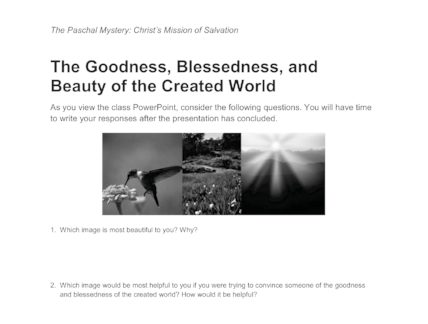
A reflection worksheet on the goodness, blessedness, and beauty of the created world.
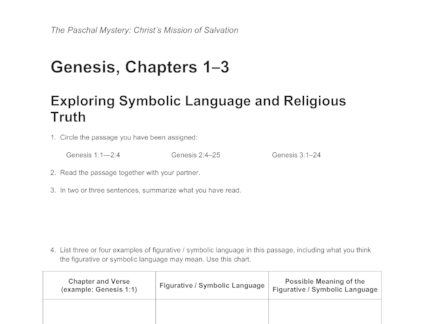
A worksheet looking at the figurative/symbolic language found in Genesis Chapters 1-3, and the possible meanings of the figurative/symbolic language.
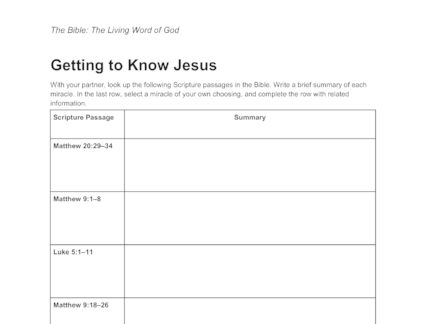
A partner activity on getting to know Jesus through Scriptural accounts of his miracles.
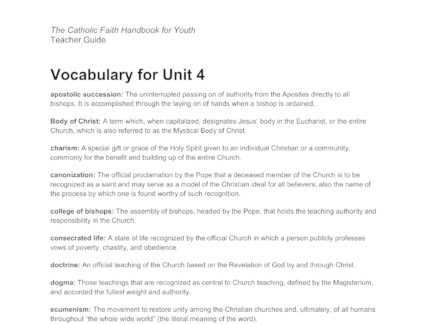
Vocabulary terms, and their definitions, for Unit 4 of The Catholic Faith Handbook for Youth Teacher Guide.
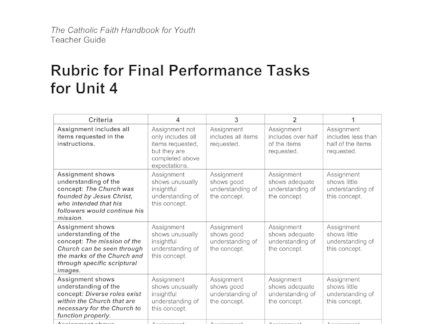
An evaluation rubric for the final performance task options for Unit 4 of The Catholic Faith Handbook for Youth Teacher Guide.
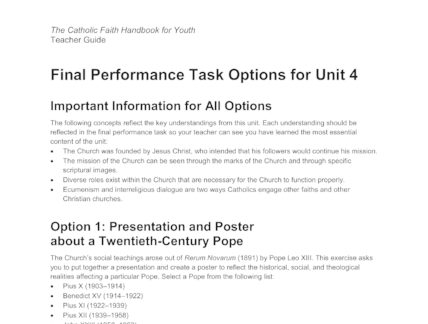
Several final performance tasks options for Unit 4 of The Catholic Faith Handbook for Youth Teacher Guide.
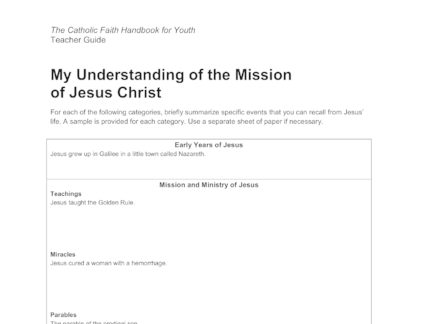
A worksheet on students’ understandings of the mission of Jesus Christ.
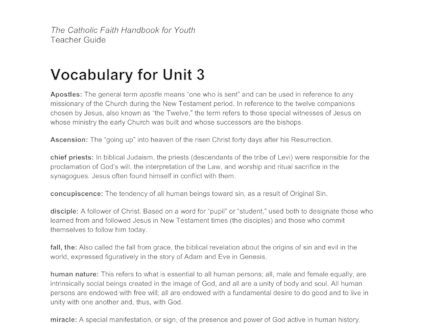
Vocabulary terms and definitions for Unit 3 of “The Catholic Faith Handbook for Youth.”
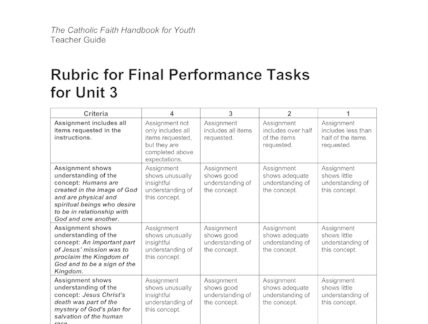
An evaluation rubric for the final performance task options for Unit 3 of “The Catholic Faith Handbook for Youth.”
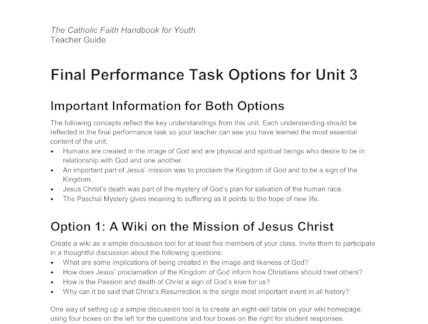
Several final performance task options for Unit 3 of “The Catholic Faith Handbook for Youth.”
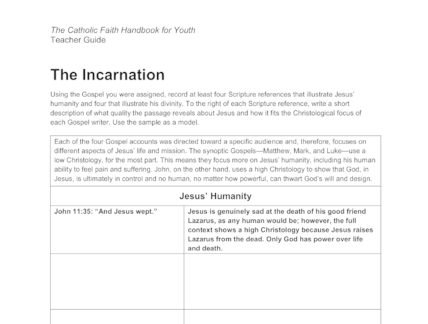
An activity where students are asked to look through Scripture to find references that illustrate Jesus’ humanity and divinity.
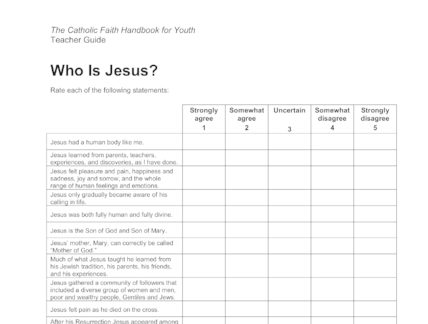
An activity where students rate their level of agreement on statements about Jesus.
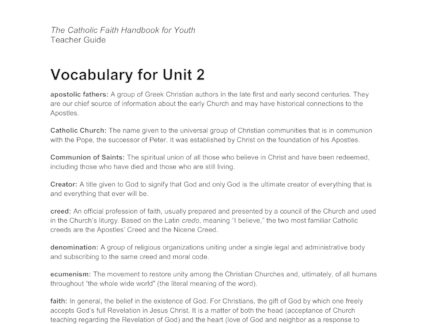
Vocabulary terms and definitions for Unit 2 of “The Catholic Faith Handbook for Youth.”
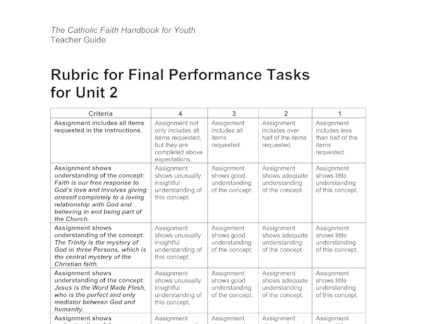
An evaluation rubric for the final performance task options for Unit 2 of “The Catholic Faith Handbook for Youth.”
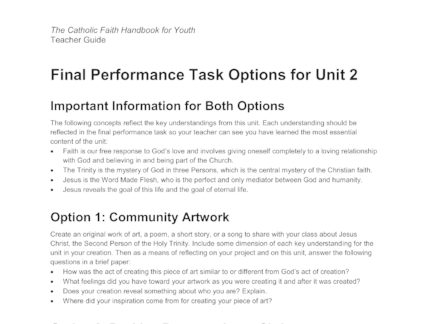
Several final performance task options for Unit 2 of “The Catholic Faith Handbook for Youth.”
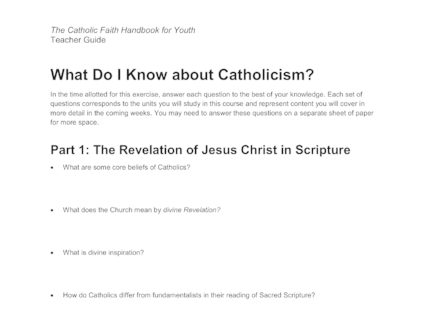
An assignment where students test their knowledge of Catholicism.
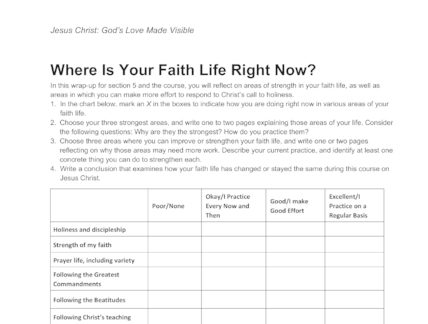
A wrap-up activity for Section 5 of “Jesus Christ: God’s Love Made Visible,” on where your Faith life is right now.
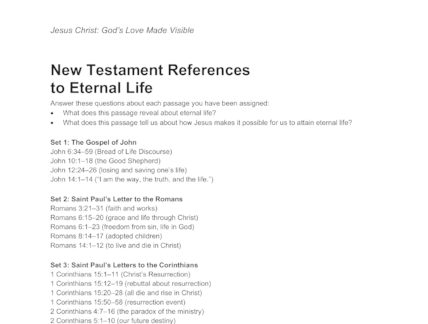
An activity that uses New Testament Scripture passages that reference eternal life, from Section 5 Part 4 of “Jesus Christ: God’s Love Made Visible.”
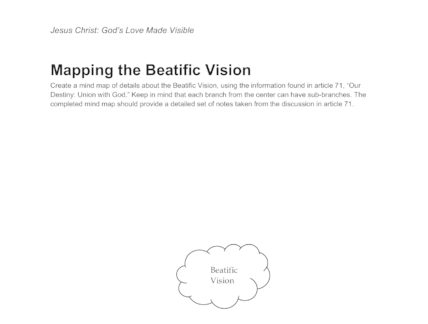
A homework assignment where students are asked to create a mind map of details about the Beatific Vision, from Section 5 Part 4 of “Jesus Christ: God’s Love Made Visible.”
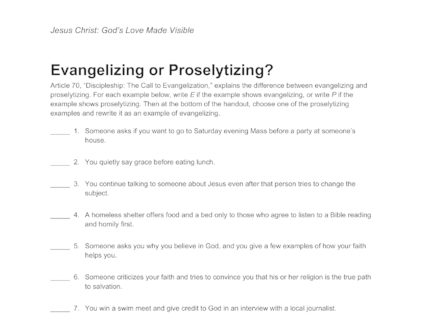
A homework assignment on evangelizing and proselytizing, from Section 5 Part 3 of “Jesus Christ: God’s Love Made Visible.”
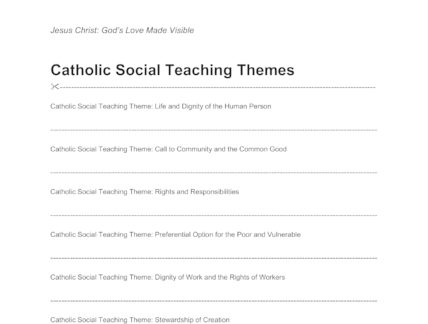
A list of Catholic Social Teaching themes that can be used in conjunction with a homework assignment, from Section 5 Part 3 of “Jesus Christ: God’s Love Made Visible.”
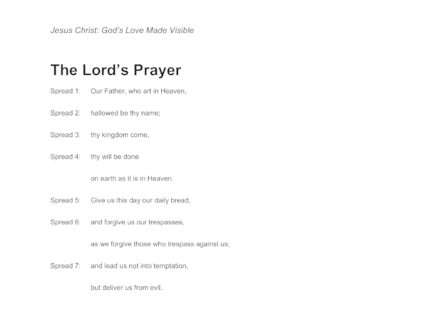
An activity on the Lord’s Prayer, from section 5 Part 2 of Jesus Christ: God’s Love Made Visible.
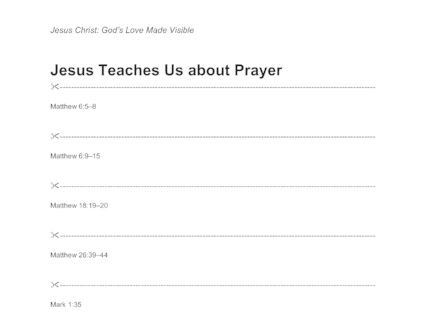
A list of scripture verses that can be used in conjunction with a homework assignment on Jesus’ teachings about prayer, from Section 5 Part 2 of “Jesus Christ: God’s Love Made Visible.”
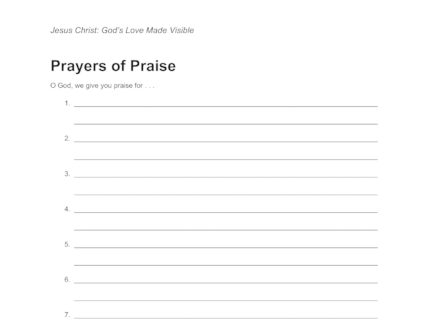
A homework assignment where students can use a template to create their own prayers of praise, from Section 5 Part 2 of “Jesus Christ: God’s Love Made Visible.”
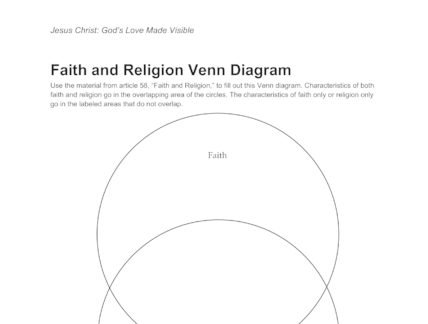
A homework assignment using a faith and religion Venn Diagram, from Section 5 Part 1 of “Jesus Christ: God’s Love Made Visible.”
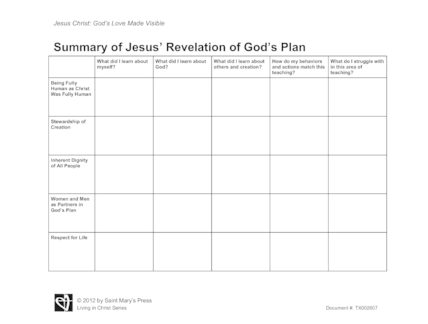
A wrap-up summary of Jesus’ Revelation of God’s plan, from Section 4 of “Jesus Christ: God’s Love Made Visible.”
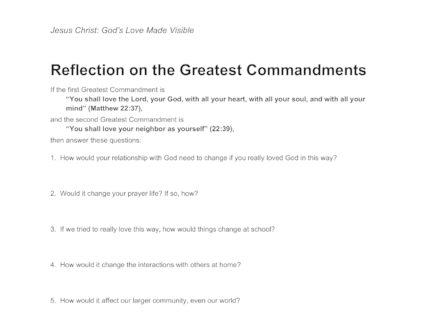
A reflective homework assignment on the greatest Commandments, from Section 4 Part 4 of “Jesus Christ: God’s Love Made Visible.”
$19.75
Copyright © 2026 Saint Mary's Press. All rights reserved. • Privacy Policy