Grace upon Grace
Students look up and read several passages about grace. The worksheet asks students to identify the purpose of grace in each and summarize the ways grace is present in their own lives.
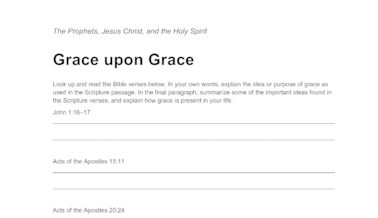
Students look up and read several passages about grace. The worksheet asks students to identify the purpose of grace in each and summarize the ways grace is present in their own lives.
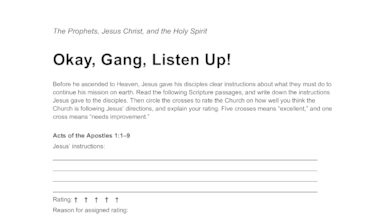
Students look up and read several passages that highlight Jesus’ instructions to his disciples. This worksheet then challenges students to reflect on how well the Church is following the instructions today.
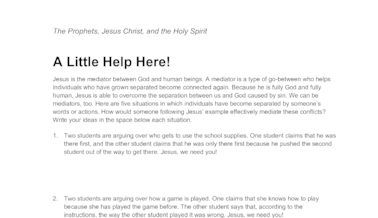
After reading several real-life examples of conflict, students provide suggestions to mediate each situation.


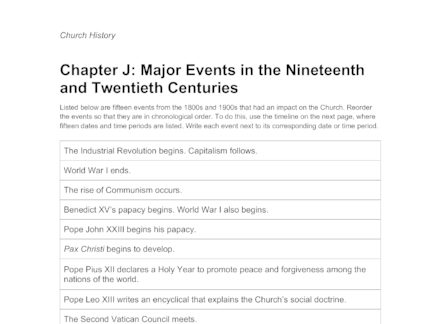
Students order important events from the 19th and 20th centuries.
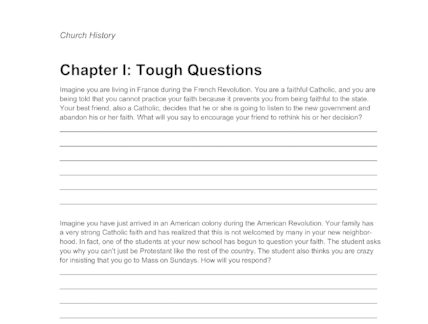
The worksheet poses several questions that ask students to reflect on how they would have stood up for their faith during the French and American Revolution.
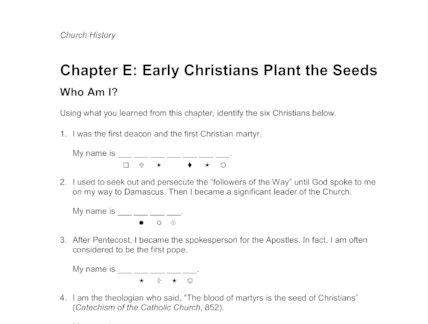
On this worksheet, students solve clues to list the names of important early Christians. These answers are then used to decode a secret message.
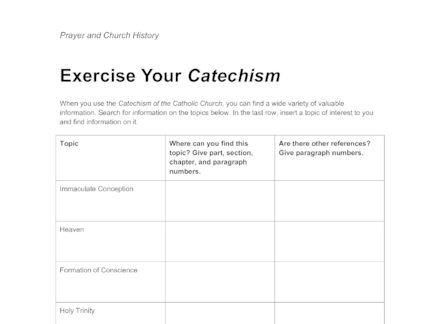
This handout guides students as they become familiar with searching for information in the Catechism of the Catholic Church.
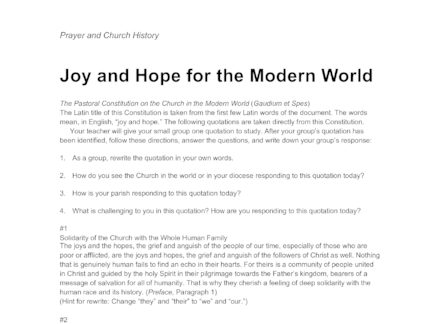
This handout provides questions for students to reflect on and answer as they read quotations from this Constitution.
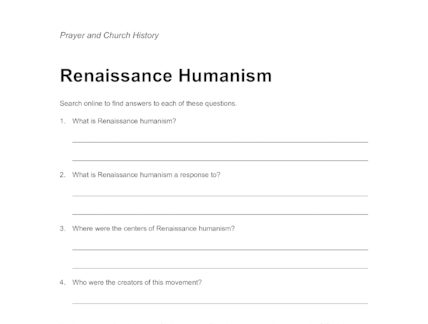
This handout provides questions for students to research on the Internet about Renaissance Humanism.
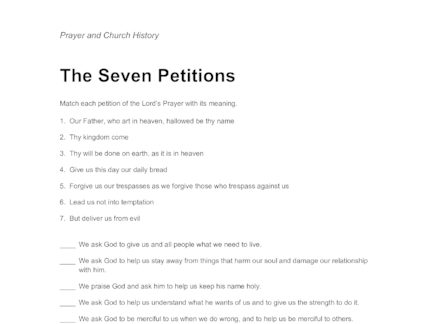
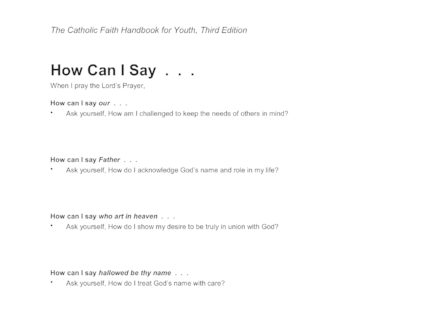
On this handout, students match the meaning to each line of the Lord’s Prayer.
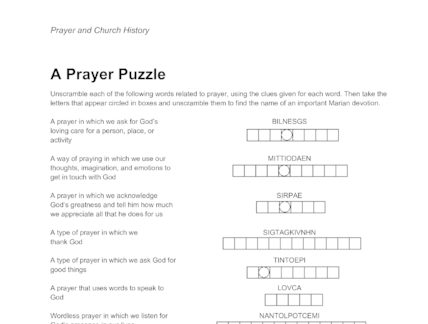
On this handout, students must use clues to unscramble words related to prayer.
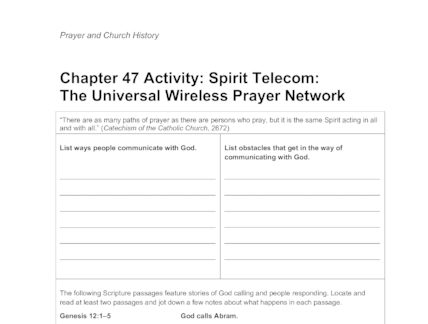
This handout guides students as they locate and read various Scripture passages focusing on the many way God calls us to prayer.
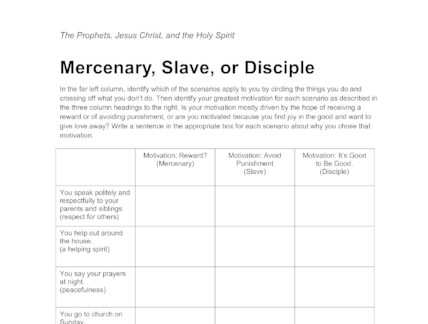
Students identify their motivation for doing good deeds before reflecting on the role of grace in their lives.
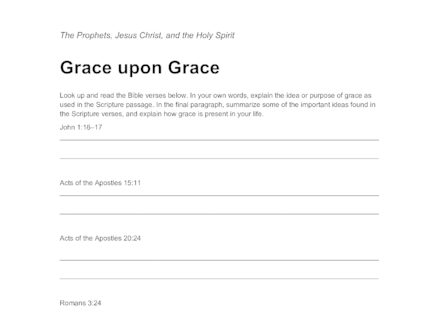
Students look up and read several passages about grace. The worksheet asks students to identify the purpose of grace in each and summarize the ways grace is present in their own lives.
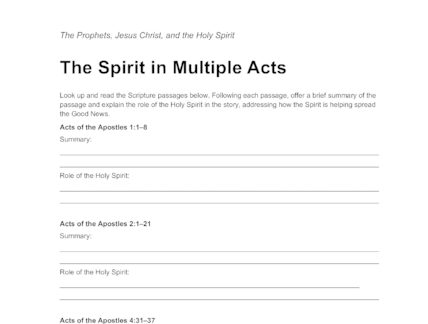
Students look up and read several passages that the Holy Spirit. The worksheet asks students to summarize each passage and describe the role of the Holy Spirit in spreading the Good News.
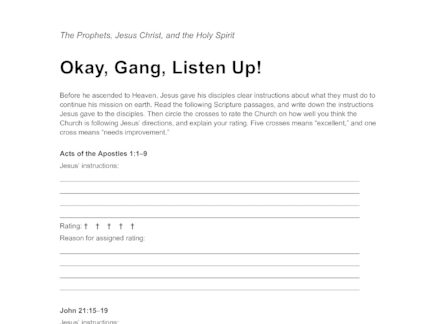
Students look up and read several passages that highlight Jesus’ instructions to his disciples. This worksheet then challenges students to reflect on how well the Church is following the instructions today.
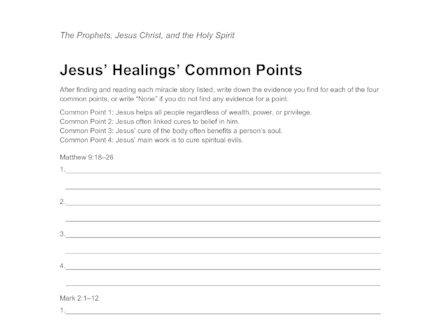
Students look up and read several miracle stories from the New Testament before identifying common points between them.
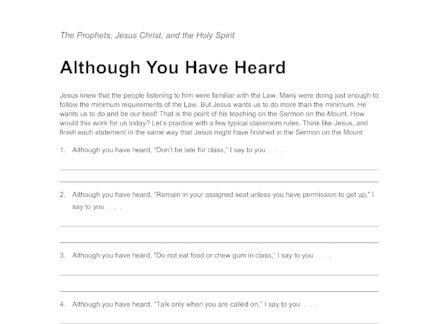
Students rewrite classroom rules modeling their responses after Jesus’ Sermon on the Mount.
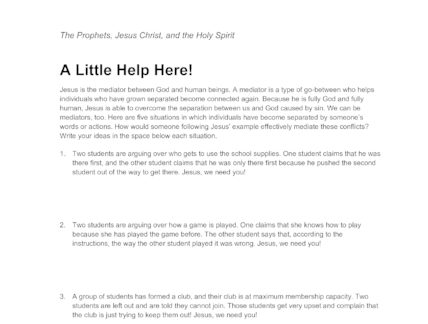
After reading several real-life examples of conflict, students provide suggestions to mediate each situation.
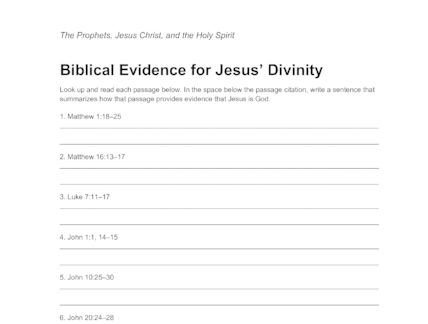
Students look up, read, and examine Scripture passages that provide evidence that Jesus is God.
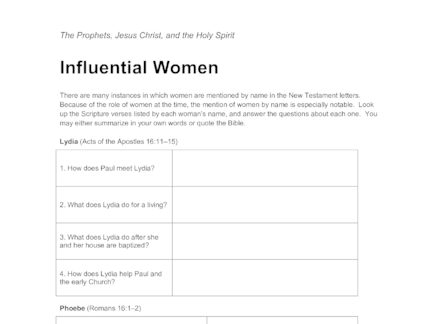
Students look up, read, and answer questions about Scripture passages that note influential women in the New Testament.
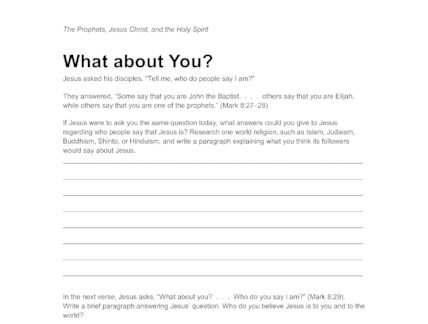
After reading Mark 8:27-29, students must answer several questions about who Jesus is to today’s world and people.
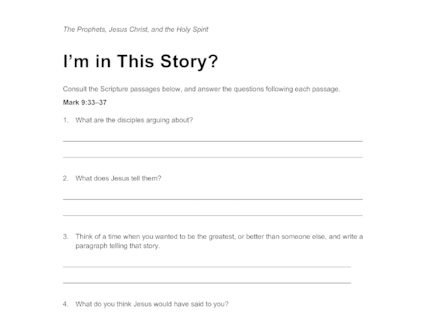
Students must look up several Scripture passages that give insight into the disciples of Jesus. This worksheet poses questions that help make Jesus’ mission relatable to students.
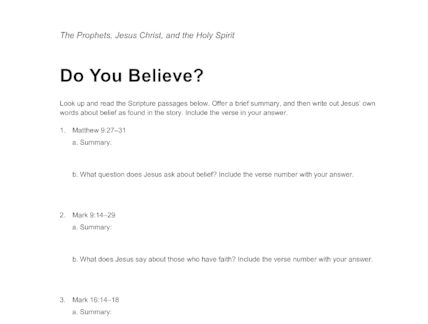
For this worksheet, students look up Scripture passages that examine the words and beliefs of Jesus in each story.
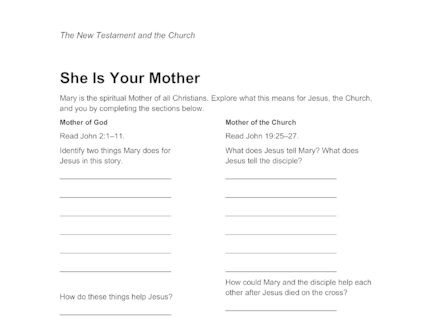
As students complete this worksheet, they will explore what it means when we say that Mary is the Mother of God and the Mother of the Church.
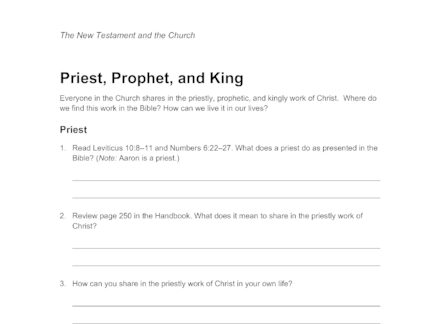
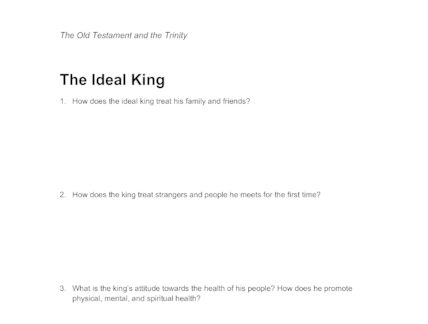
Students find examples in the Bible of the priestly, prophetic, and kingly work of Christ before applying it to their own lives.
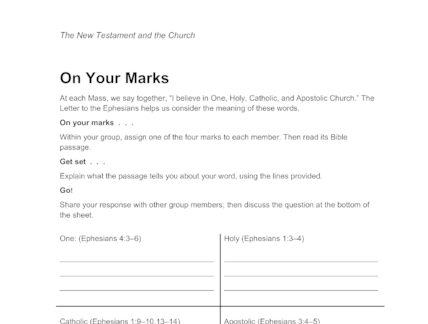
This worksheet guides group members to work together as they identify the importance of the church being “One, Holy, Catholic, and Apostolic”.
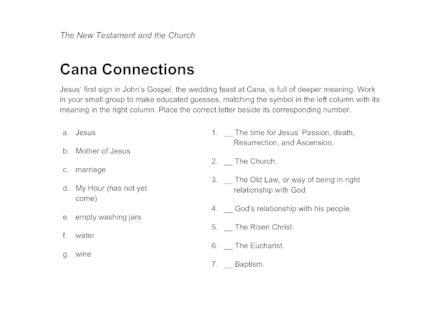
Students match symbols from Jesus’ first miracle the wedding feast in Cana with their meaning and significance.
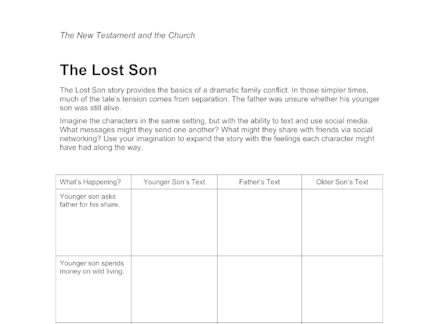
On this worksheet, students retell the story of the Prodigal Son using texting and social media messages.
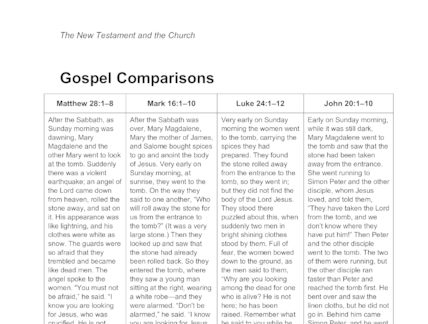
On this worksheet, students read all four Gospel accounts of the resurrection before identifying similarities and differences between them.
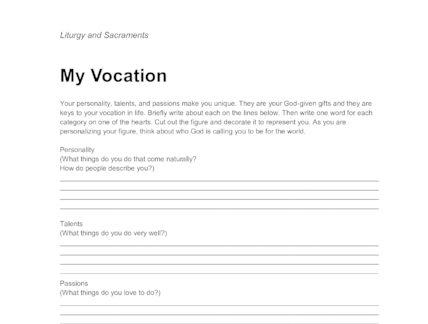
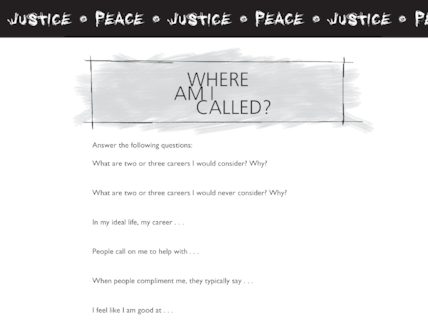
This handout helps students identify their talents, gifts, and personality and how these fit into God’s vocation for their lives.
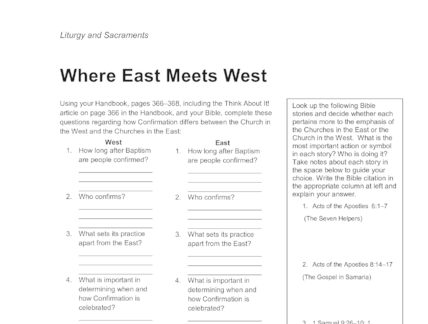
This worksheet guides students to make connections between Confirmation in the Eastern and Western Churches.
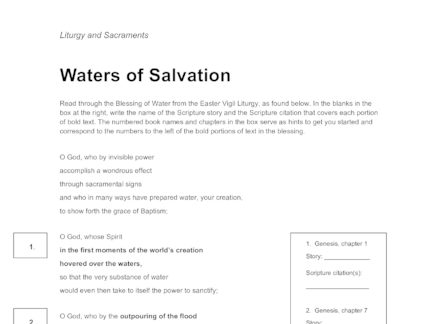
On this worksheet, students identify the Scripture passages associated with the various parts of the Blessing of the Water used at the Easter Vigil.
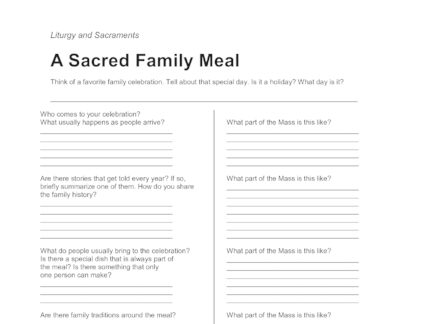
This worksheet guides students to make connections between the Mass and a special meal or tradition in their family.
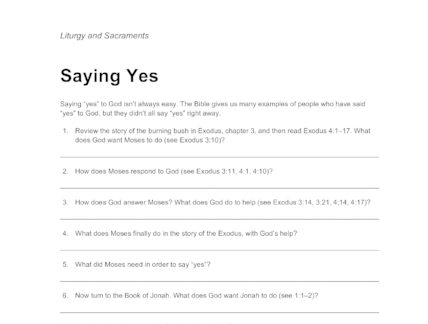
This handout guides students to examine several Scripture passages exemplifying what it means to say “yes” to God’s call.
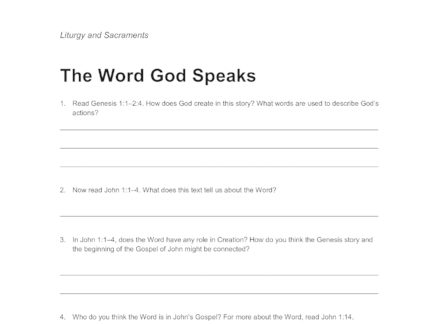
This worksheet helps students to explore the meaning of “the Word” in John’s Gospel and throughout Scripture.
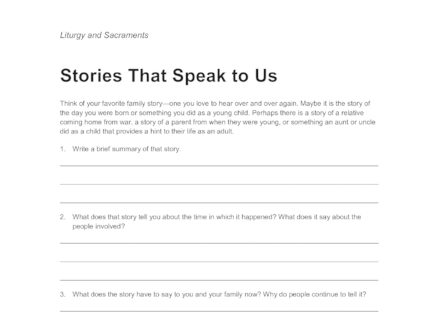
This handout guides students to recognize the importance of stories, both in our families and our faith.
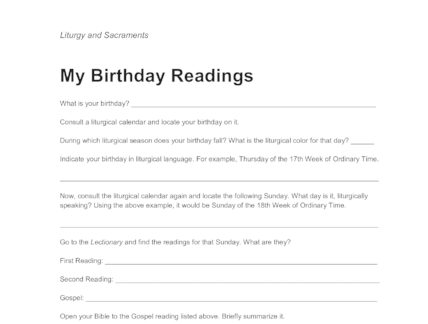
Students identify the liturgical season in which their birthday falls. This worksheet then guides them to identify and summarize the readings for that day.
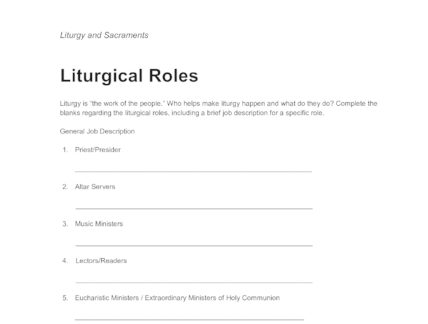
This handout asks students to identify the role of the various liturgical ministers at Mass.
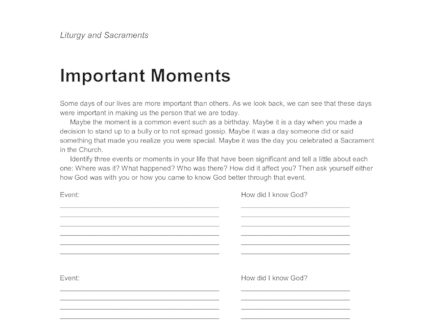
This handout asks students to think about and reflect on moments in their life that have been significant.
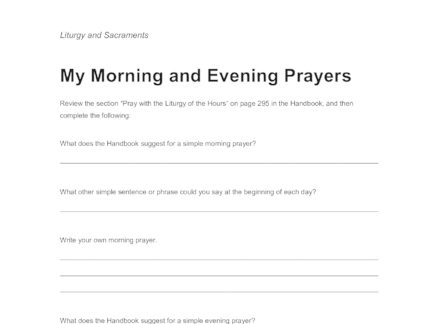
This handout asks students to think about the Liturgy of the Hours before they answer questions about and create their own morning and evening prayers.
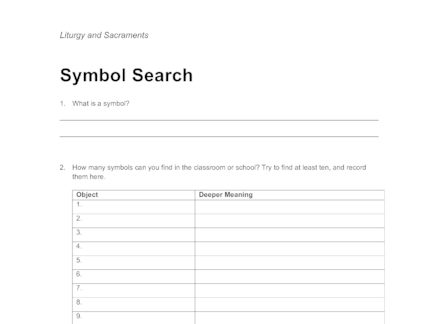
This handout challenges students to find symbols in their classroom or school and identify the deeper meaning of each.
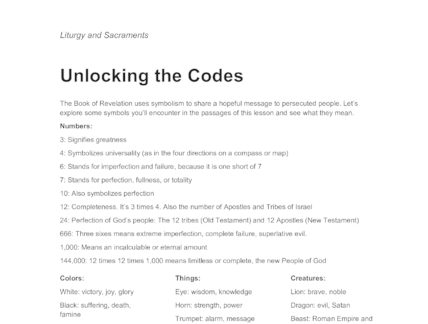
This handout provides several short activities for students to complete as they learn about the symbolism of the Book of Revelation.
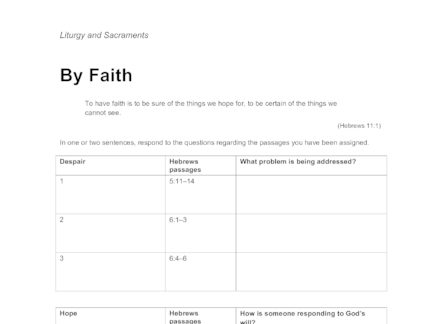
This worksheet guides students to read numerous passages from the Bible regarding despair, faith, and hope. Students are then asked to draw connections between the passages and heroes.
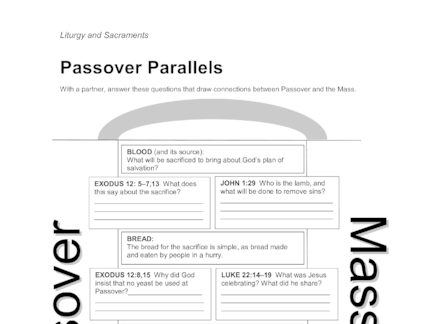
This partner worksheet helps students draw connections between Old Testament passage about the Passover and New Testament passages about the Mass.
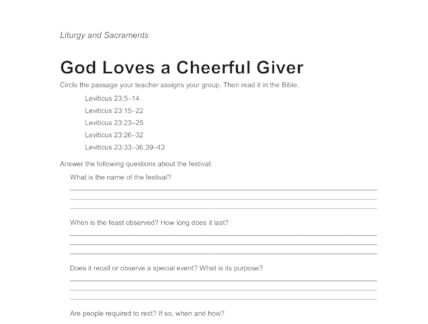
This worksheet guides students to read and answer questions about a specific Hebrew festival from the book of Leviticus.
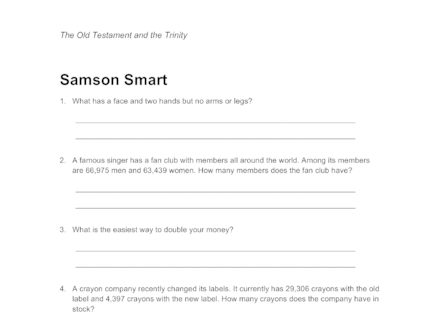
This is a set of riddles to challenge students as they learn about Samson in the Old Testament.
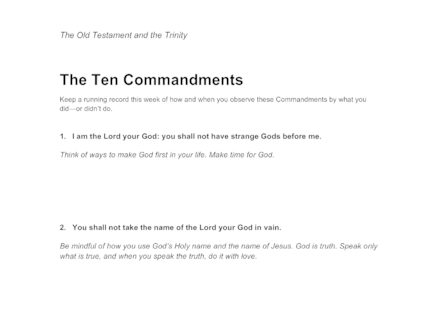
This handout asks students to keep a running record of how they observe the Ten Commandments in their actions throughout a week.
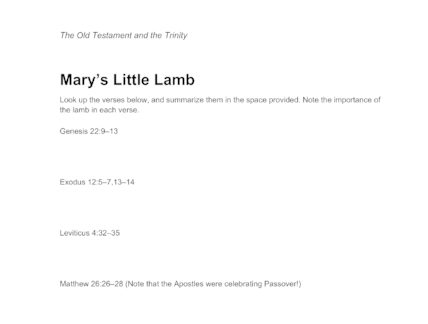
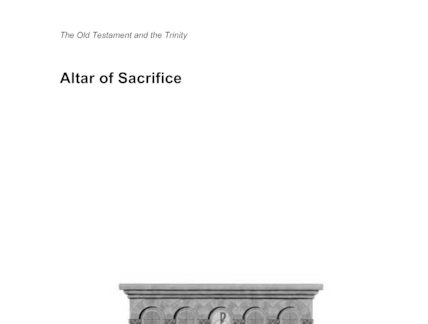
This worksheet helps students to reflect on the numerous images of the lamb found in Scripture.
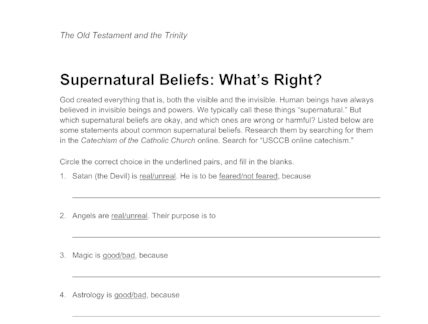
This worksheet guides students to identify and research Church teachings on supernatural beings.
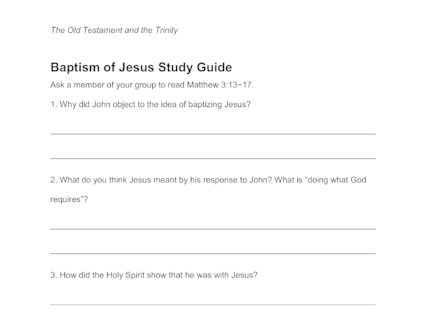
This study guide helps students reflect on the story of Jesus’ Baptism.
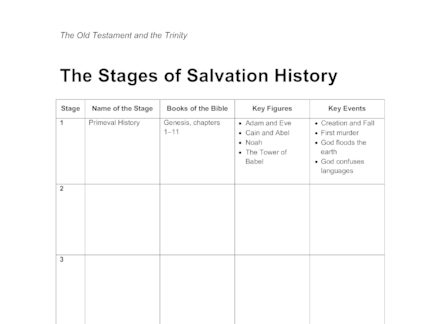
This chart allows students to organize information about the stages of salvation history.
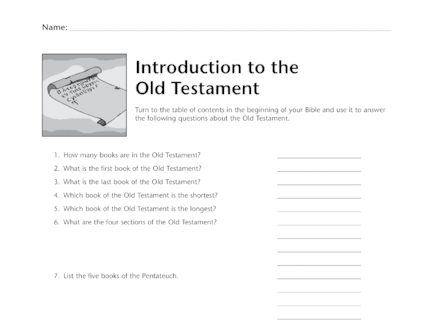
This worksheet guides students to explore and become familiar with the sections of the Old Testament.
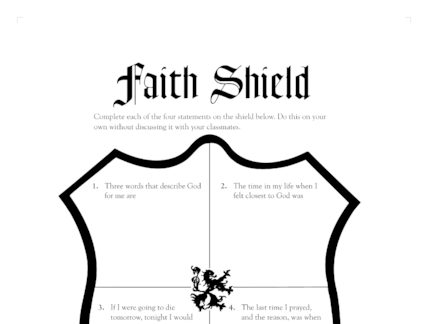
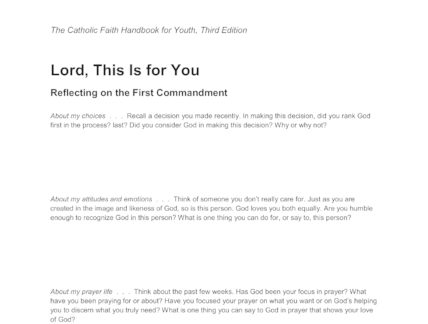
An individual activity that asks students about their faith and their relationship with God.
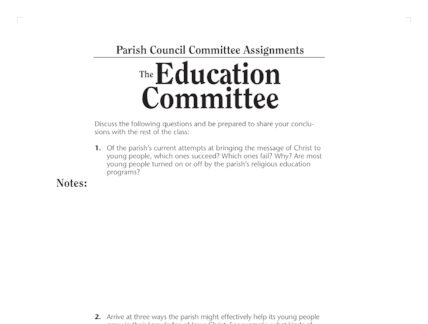
This handout assigns students to a made-up Parish Council Committee. Students must then brainstorm ideas and activities to help engage young people in the life of the parish.
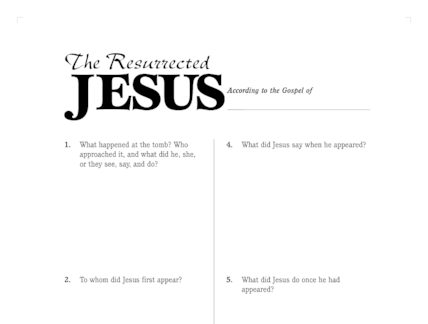
Students answer questions about the story of Jesus' Resurrection from one of the four Gospels.
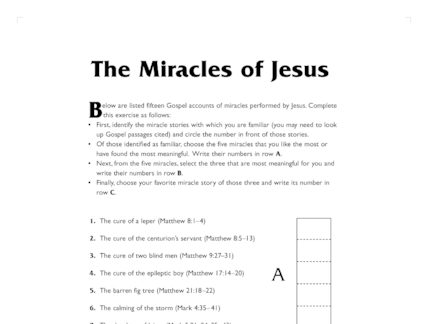
Students review many familiar miracles performed by Jesus in the gospels before choosing a favorite.
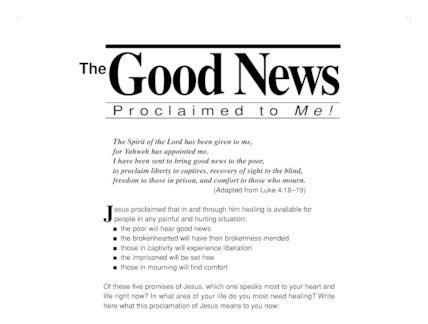
This handout asks students to reflect and write about the ways that Jesus' healing is needed in their lives.
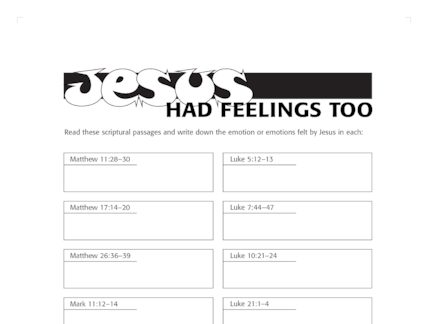
Students read passages from the Gospels to explore the numerous emotions that Jesus experienced during his time on Earth.
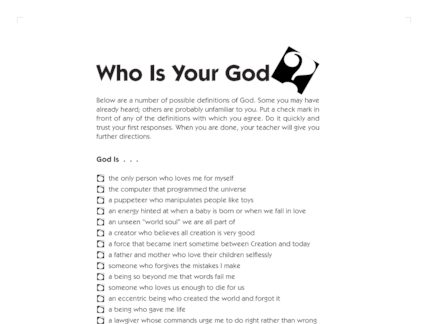
This handout presents a list of different definitions and identities for God. Students are asked to choose ones that resonate with them.
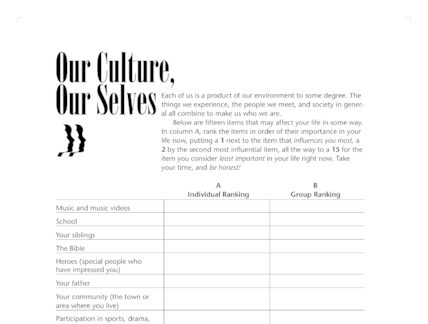
This handout asks students to rank a list of items in life and society according to their importance.
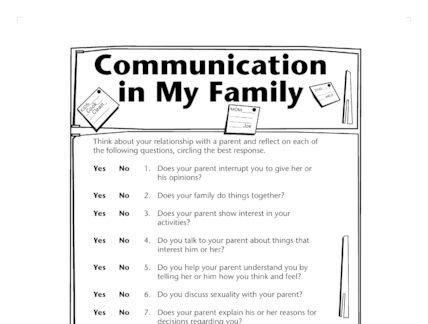
This handout helps students to explore the communication and relationship they have with their parents by asking a series of reflective questions for students to answer.
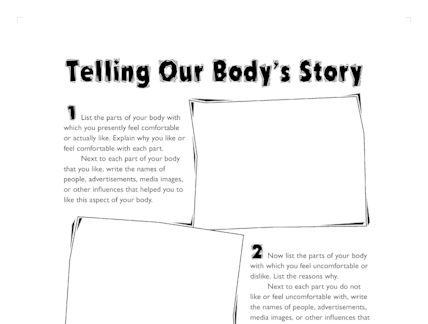
This handout helps teens reflect on their body image and the influences on their attitudes towards their bodies.
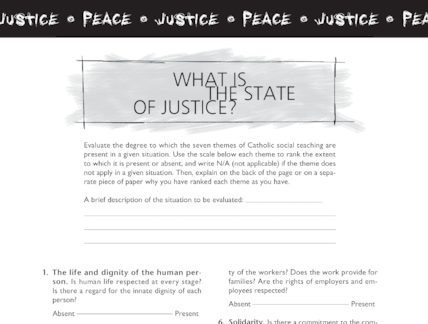
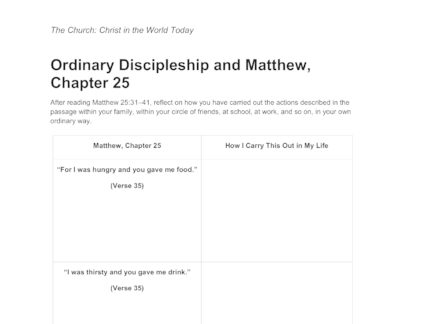
Evaluate the degree to which the seven themes of Catholic social teaching are present in a given situation. Use the scale below each theme to rank the extent to which it is present or absent, and write N/A (not applicable) …
Brief description of organization/agency/group and the nature of its work: How does it build relationships? promote justice?
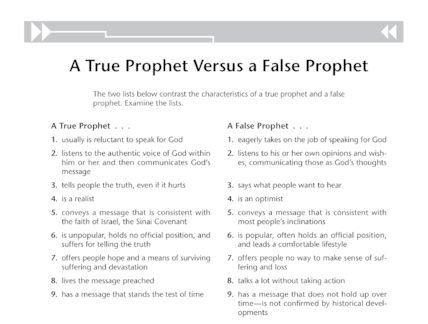
The two lists below contrast the characteristics of a true prophet and a false prophet. Examine the lists.
1. Look at the statue or picture at this station. 2. This image depicts the deity Kuan-yin. Write words that describe this image.
1. Look at the picture at this station. 2. Write words that describe the actions that you see in the picture. 3. Write words that describe the relationships between people that you see in the picture.
1. At this station are several objects. Some may look familiar. Gently pick up each object and examine it. SOME OF THE OBJECTS ARE FRAGILE. PLEASE HANDLE THEM CAREFULLY. 2. Write the following information about each object.
For each of the following actions, write a selfish motivation and a selfless motivation. Responses have been supplied for the first action as examples.
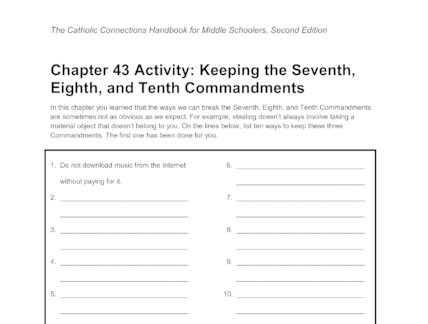
Students are asked to list 10 practical ways to keep the 7th, 8th, and 10th Commandments.
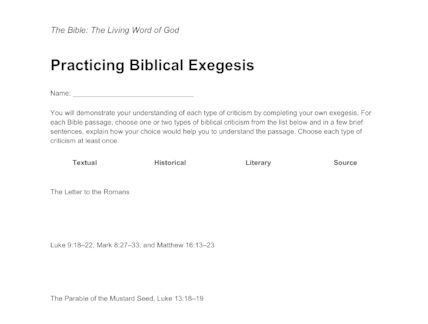
A worksheet where students are asked to demonstrate their understanding of biblical criticism by completing their own exegesis.
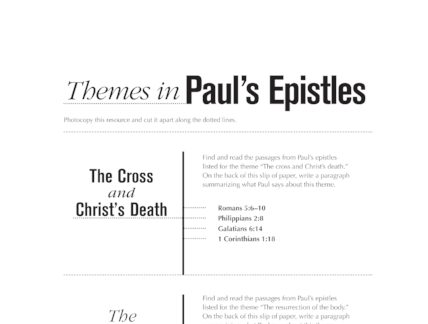
An artistic presentation of several themes in Paul’s epistles, and the Scripture passages they correspond to.
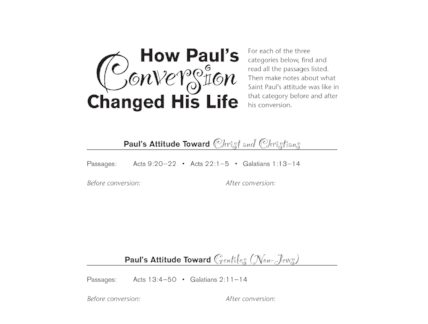
A worksheet using Scripture passages to show how Saint Paul’s attitude toward Christ and Christians, Gentiles, and his enemies changed after his conversion.
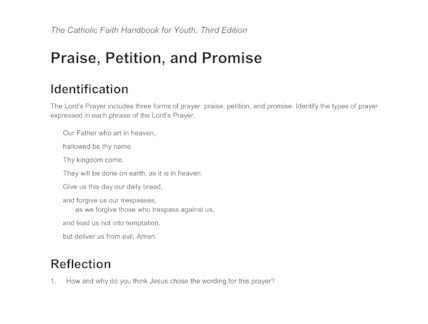
The Lord’s Prayer includes three forms of prayer: praise, petition, and promise. Identify the types of prayer expressed in each phrase of the Lord’s Prayer.
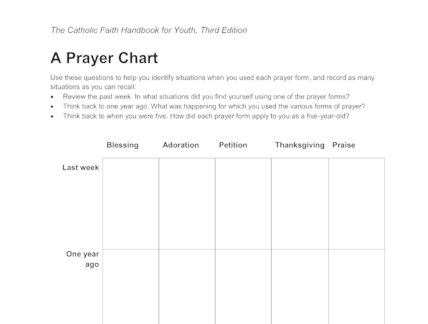
Use these questions to help you identify situations when you used each prayer form, and record as many situations as you can recall.
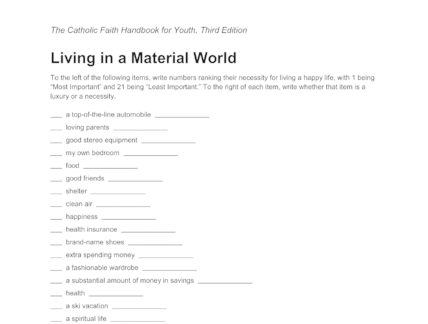
A worksheet where students are asked to rank items on their necessity for living a happy life.
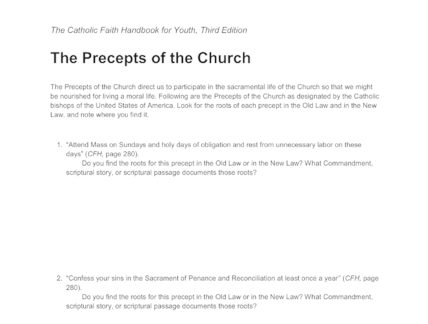
The Precepts of the Church direct us to participate in the sacramental life of the Church so that we might be nourished for living a moral life. Following are the Precepts of the Church as designated by the Catholic bishops …
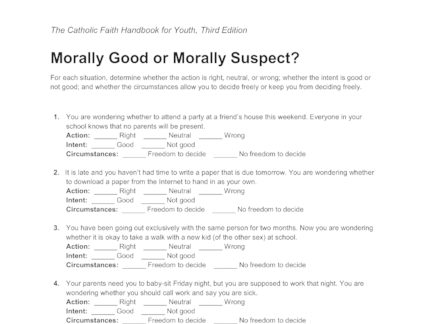
For each situation, determine whether the action is right, neutral, or wrong; whether the intent is good or not good; and whether the circumstances allow you to decide freely or keep you from deciding freely.
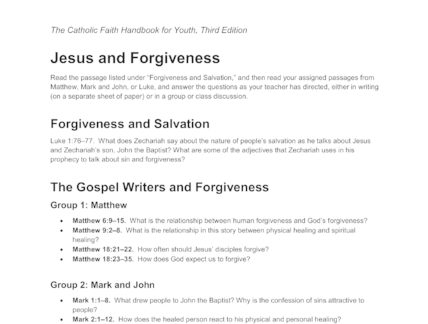
Read the passage listed under “Forgiveness and Salvation,” and then read your assigned passages from Matthew, Mark and John, or Luke, and answer the questions as your teacher has directed, either in writing (on a separate sheet of paper) or …
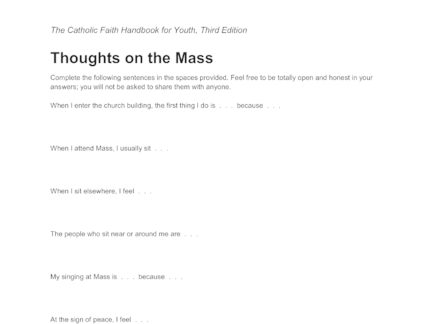
Complete the following sentences in the spaces provided. Feel free to be totally open and honest in your answers; you will not be asked to share them with anyone.
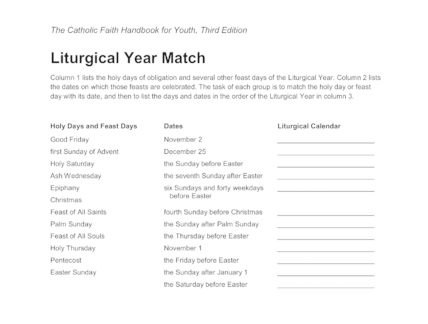
Column 1 lists the holy days of obligation and several other feast days of the Liturgical Year. Column 2 lists the dates on which those feasts are celebrated. The task of each group is to match the holy day or …
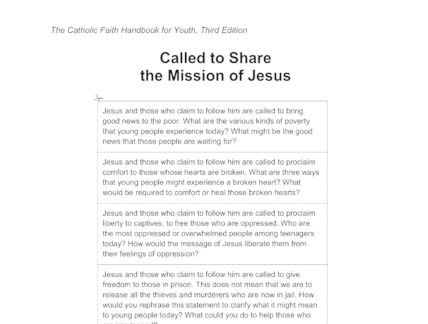
Questions about how we can imitate Jesus’ example in the way we interact with others.
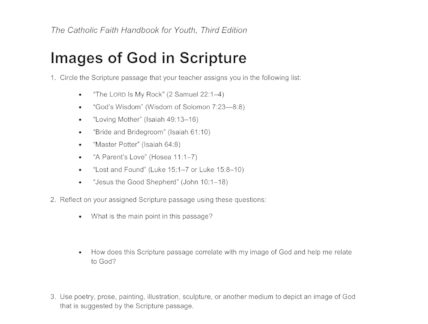
Circle the Scripture passage that your teacher assigns you in the following list. Reflect on your assigned Scripture passage using the questions below. Use poetry, prose, painting, illustration, sculpture, or another medium to depict an image of God that is …
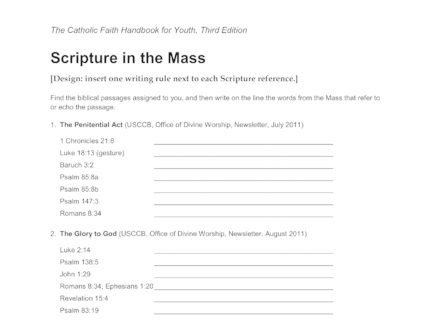
Find the biblical passages assigned to you, and then write on the line the words from the Mass that refer to or echo the passage.
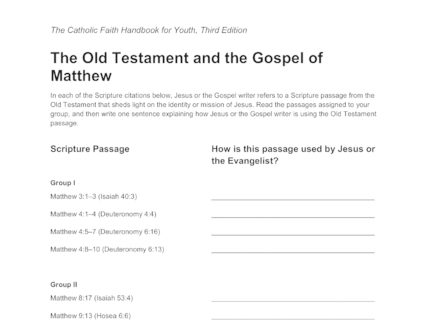
In each of the Scripture citations below, Jesus or the Gospel writer refers to a Scripture passage from the Old Testament that sheds light on the identity or mission of Jesus. Read the passages assigned to your group, and then …
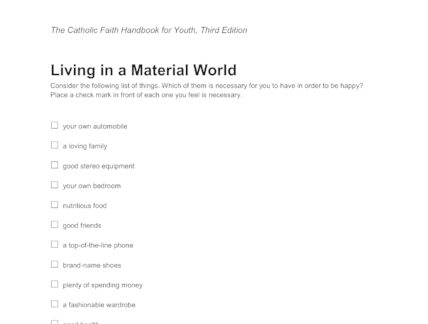
Consider the following list of things. Which of them is necessary for you to have in order to be happy? Place a check mark in front of each one you feel is necessary.
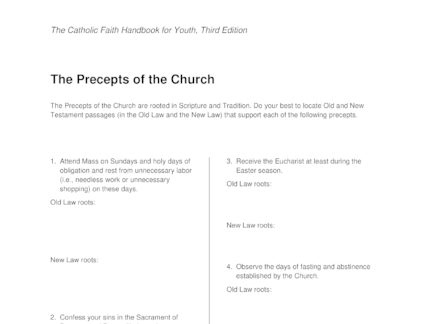
The Precepts of the Church are rooted in Scripture and Tradition. Do your best to locate Old and New Testament passages (in the Old Law and the New Law) that support each of the following precepts.
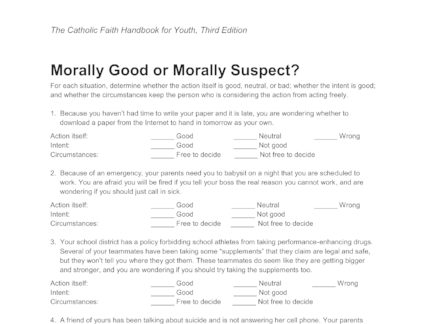
For each situation, determine whether the action itself is good, neutral, or bad; whether the intent is good; and whether the circumstances keep the person who is considering the action from acting freely.
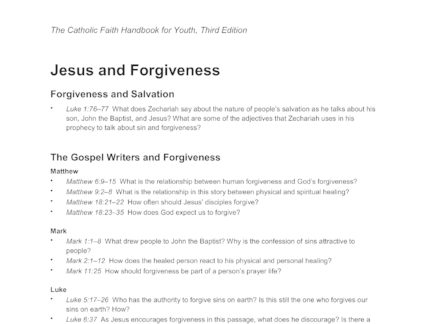
Questions about Scripture verses that talk about forgiveness and salvation.
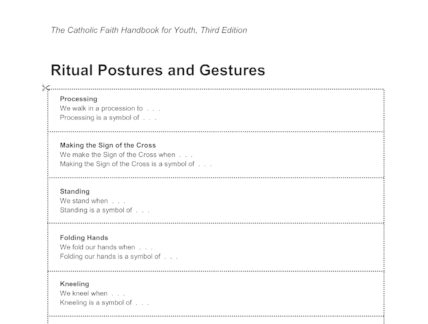
The different postures and gestures that take place during Mass.
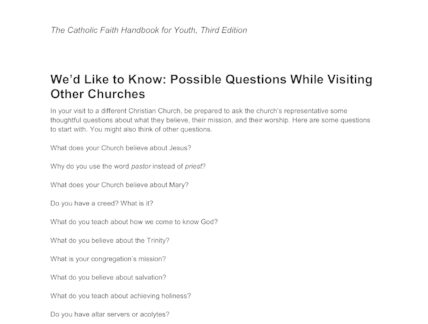
In your visit to a different Christian Church, be prepared to ask the church’s representative some thoughtful questions about what they believe, their mission, and their worship. Here are some questions to start with. You might also think of other …
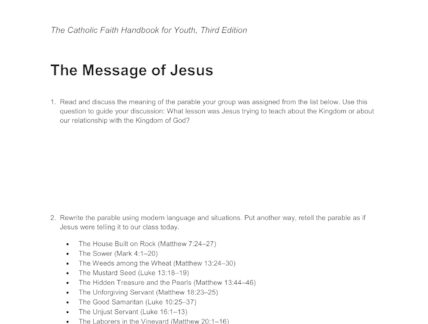
Read and discuss the meaning of the parable your group was assigned from the list below. Use this question to guide your discussion: What lesson was Jesus trying to teach about the Kingdom or about our relationship with the Kingdom …
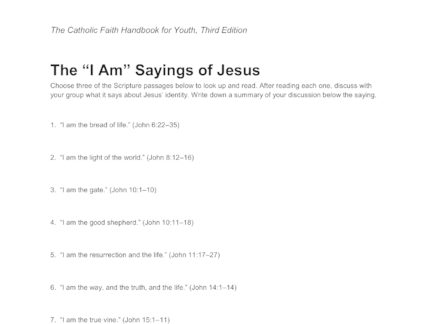
Choose three of the Scripture passages below to look up and read. After reading each one, discuss with your group what it says about Jesus’ identity. Write down a summary of your discussion below the saying.
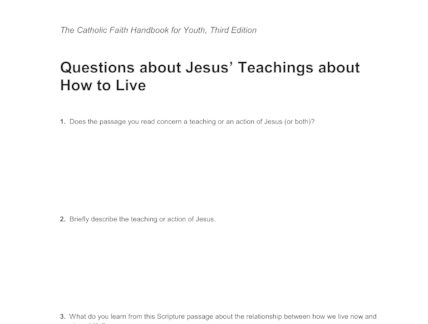
Questions about Bible passages where Jesus teaches how to live.
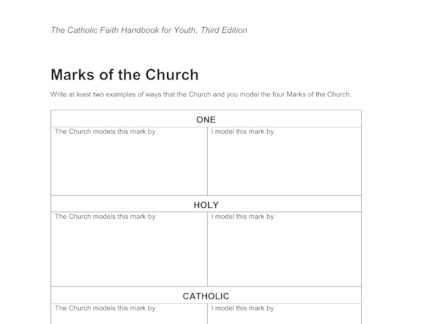
Write at least two examples of ways that the Church and you model the four Marks of the Church.
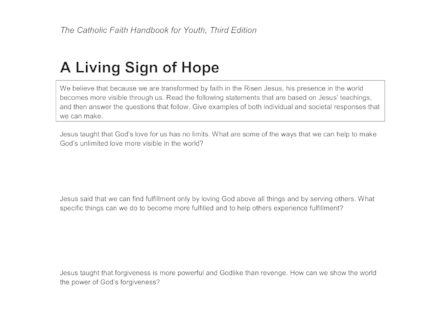
We believe that because we are transformed by faith in the Risen Jesus, his presence in the world becomes more visible through us. Read the following statements that are based on Jesus’ teachings, and then answer the questions that follow. …
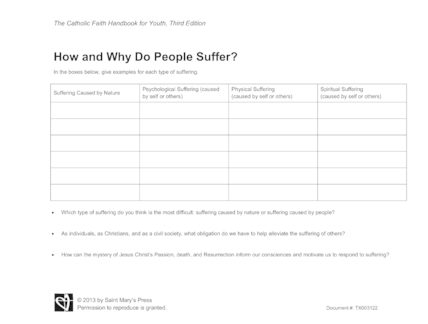
In the boxes below, give examples for each type of suffering, and respond to the questions that follow.
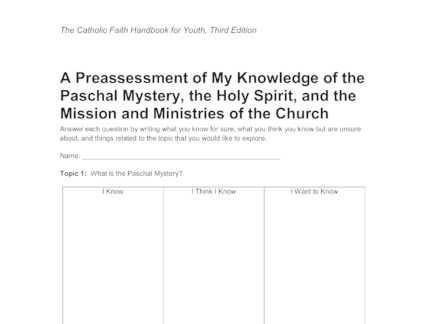
Answer each question by writing what you know for sure, what you think you know but are unsure about, and things related to the topic that you would like to explore.
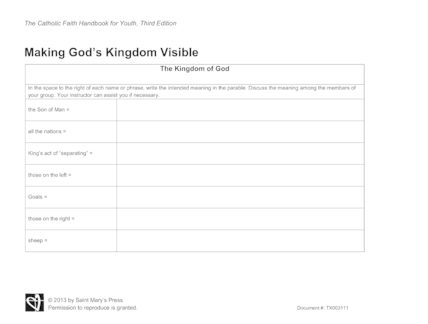
In the space to the right of each name or phrase, write the intended meaning in the parable. Discuss the meaning among the members of your group. Your instructor can assist you if necessary. Describe people or groups that these …
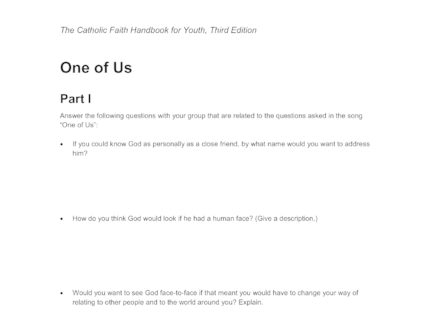
Answer the following questions with your group that are related to the questions asked in the song “One of Us”. Your instructor will lead you through Part II. Use the following questions as prompts for taking notes in your notebook.
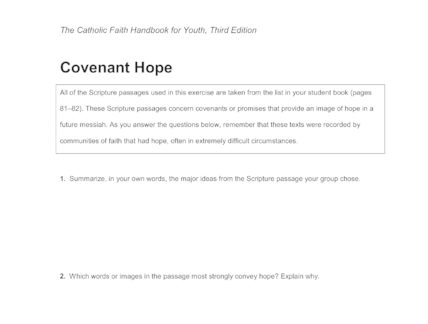
All of the Scripture passages used in this exercise are taken from the list in your student book (pages 81–82). These Scripture passages concern covenants or promises that provide an image of hope in a future messiah. As you answer …
You will be guided through this handout, taking notes and answering questions as directed in your class.
In silence, answer all but the last question by yourself. The last question will be answered in small groups.
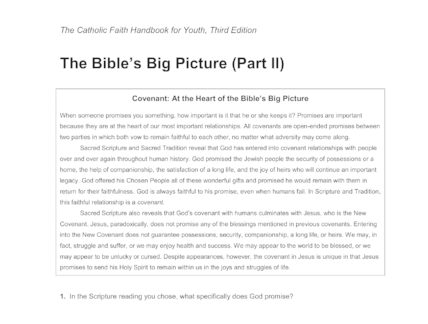
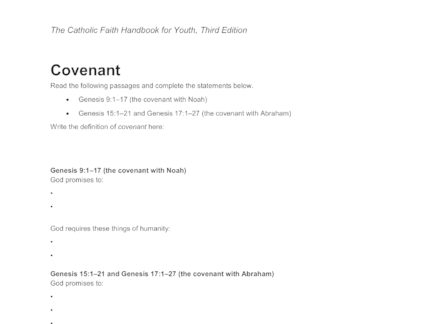
A description of what a Covenant is, and discussion questions about God’s promises.
Read through the following questions and discuss your answers with your small group.
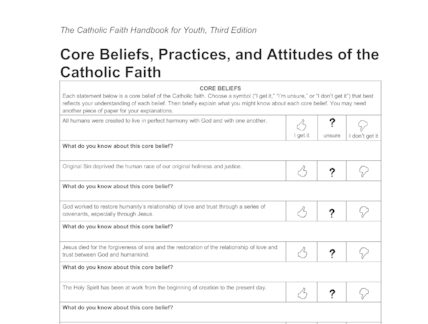
Each statement below is a core belief of the Catholic faith. Choose a symbol (“I get it,” “I’m unsure,” or “I don’t get it”) that best reflects your understanding of each belief. Then briefly explain what you might know about …
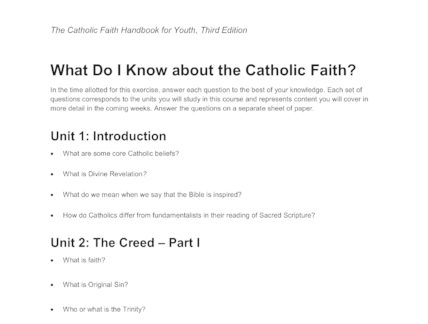
In the time allotted for this exercise, answer each question to the best of your knowledge. Each set of questions corresponds to the units you will study in this course and represents content you will cover in more detail in …
Everyone knows what it feels like to be on the inside and the outside of a group of people. Fill in the statements below, and then write a prayer to Jesus asking for his help when you are an outsider …
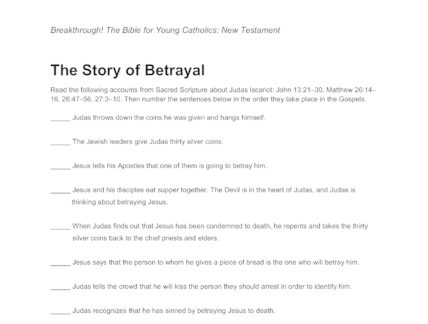
Read the following accounts from Sacred Scripture about Judas Iscariot: John 13:21–30, Matthew 26:14–16, 26:47–56, 27:3–10. Then number the sentences below in the order they take place in the Gospels.
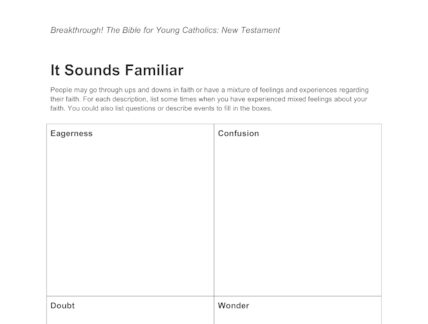
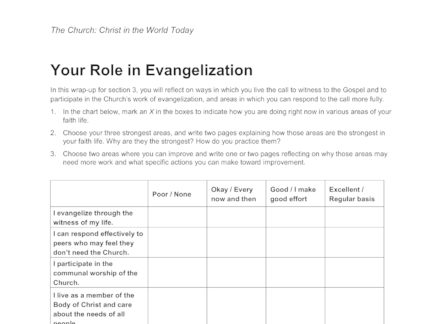
People may go through ups and downs in faith or have a mixture of feelings and experiences regarding their faith. For each description, list some times when you have experienced mixed feelings about your faith. You could also list questions …
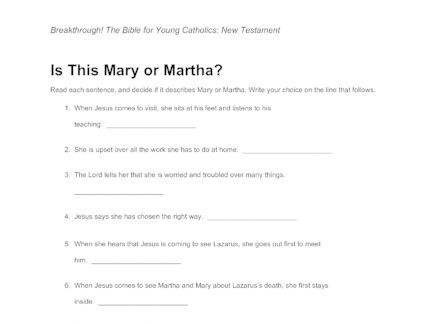
Read each sentence, and decide if it describes Mary or Martha. Write your choice on the line that follows.
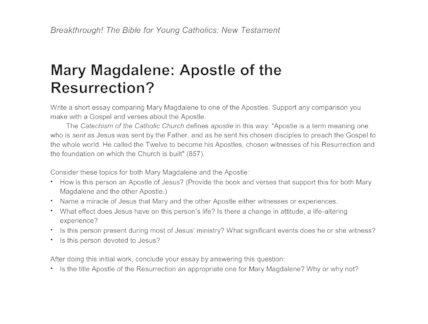
Write a short essay comparing Mary Magdalene to one of the Apostles. Support any comparison you make with a Gospel and verses about the Apostle.
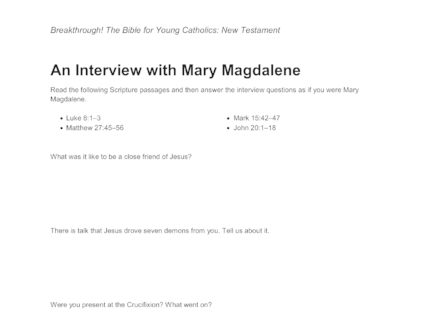
Read the following Scripture passages and then answer the interview questions as if you were Mary Magdalene.
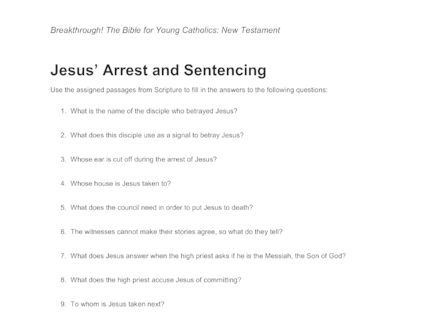
Use the assigned passages from Scripture to fill in the answers to the following questions.
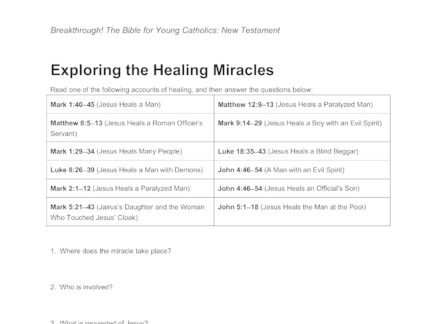
Read one of the following accounts of healing, and then answer the questions below.
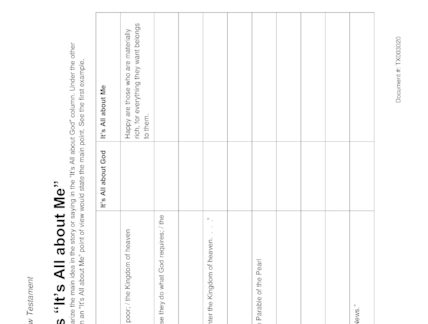
Look up the Kingdom of God Scripture passage(s), and summarize the main idea in the story or saying in the “It’s All about God” column. Under the other column for that same passage, write how someone writing from an “It’s …
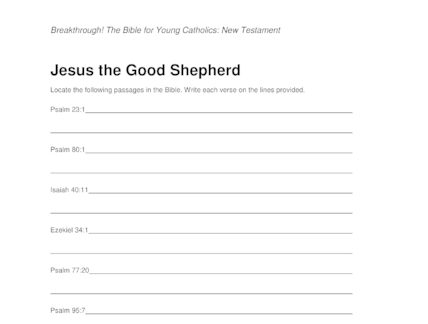
Locate the following passages in the Bible. Write each verse on the lines provided.
Next to each phrase from the Lord’s Prayer, write another version of the phrase, using more current language or simply putting the words in a different way.
Read the Gospel passages below, and write a summary statement or two about what Jesus tells us about prayer.
Brainstorm personal family issues that are of concern to you as well as any issues that may be troubling your friends. Using the outline below as a guide, write a personal intercessory prayer in the blank space.
Match the events in Jesus’ life outlined below with the articles from the United Nations documents “Universal Declaration of Human Rights” and “United Nations Convention on the Rights of the Child,” outlined on the handout “Human Rights” (Document #: TX003012), …
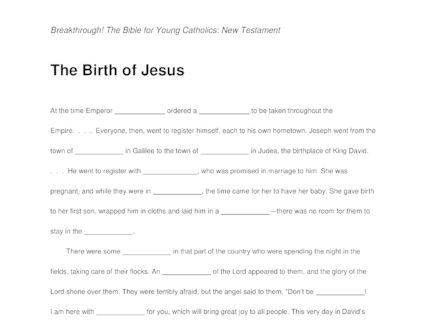
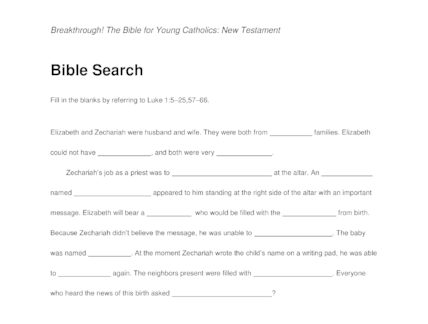
A fill in the blank worksheet from the birth narrative of Jesus in the Gospel of Luke.
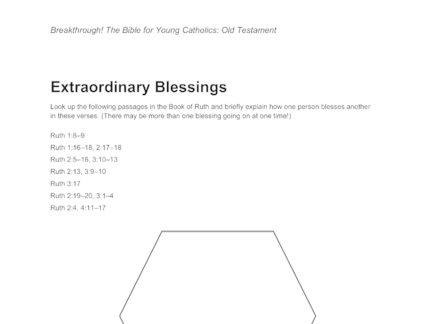
Look up the following passages in the Book of Ruth and briefly explain how one person blesses another in these verses. (There may be more than one blessing going on at one time!)
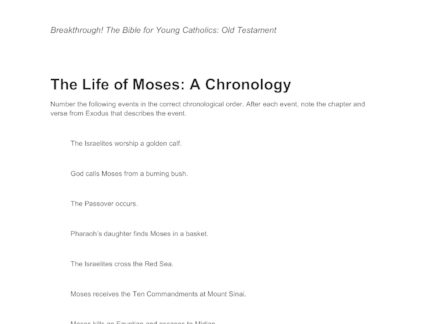
Number the following events in the correct chronological order. After each event, note the chapter and verse from Exodus that describes the event.
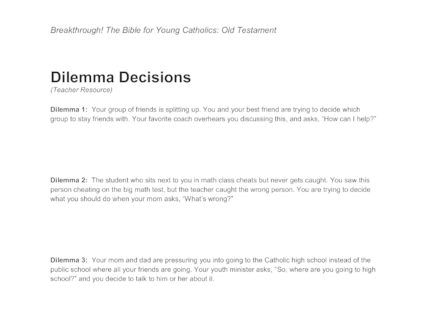
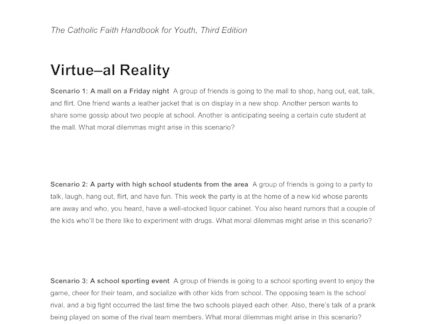
A worksheet with tough decisions students may be faced with in their lives.
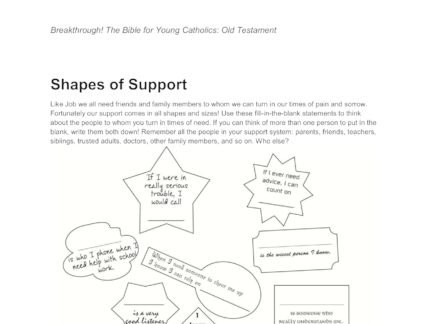
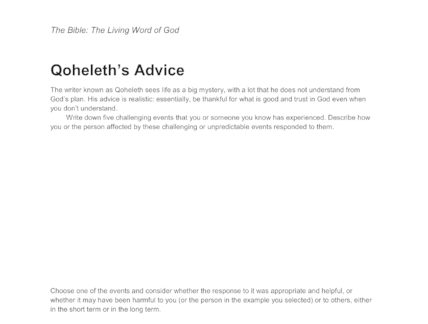
Like Job we all need friends and family members to whom we can turn in our times of pain and sorrow. Fortunately our support comes in all shapes and sizes! Use these fill-in-the-blank statements to think about the people to …
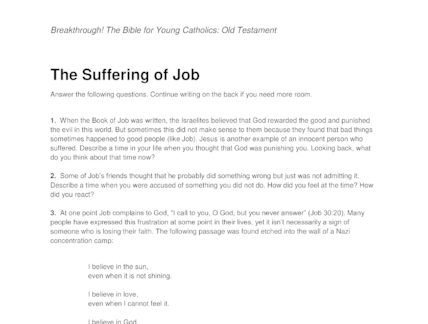
A worksheet with questions about how the book of Job applies to the students’ lives.
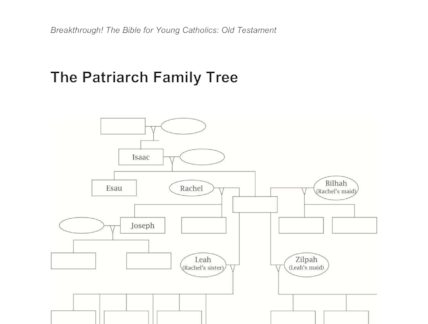
A fill in the blank family tree of several generations of people in the Old Testament.
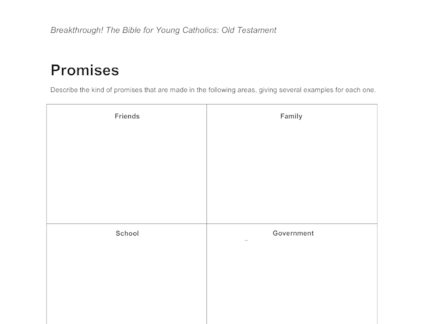
Describe the kind of promises that are made in the following areas, giving several examples for each one.
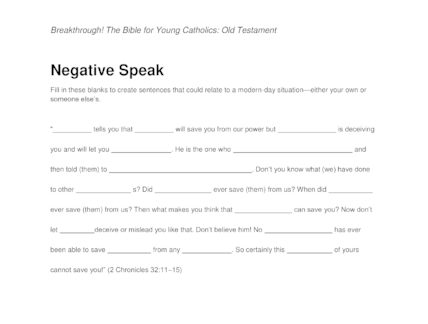
Fill in these blanks to create sentences that could relate to a modern-day situation—either your own or someone else’s.
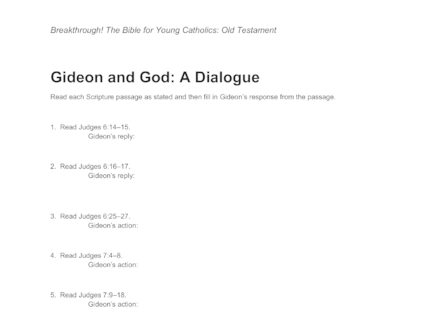
Read each Scripture passage as stated and then fill in Gideon’s response from the passage.
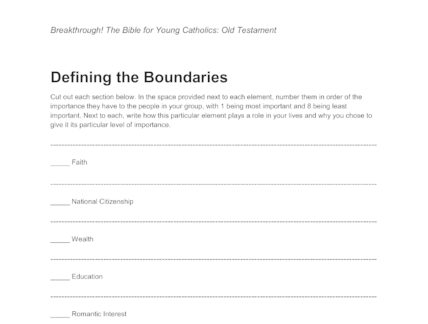
Cut out each section below. In the space provided next to each element, number them in order of the importance they have to the people in your group, with 1 being most important and 8 being least important. Next to …
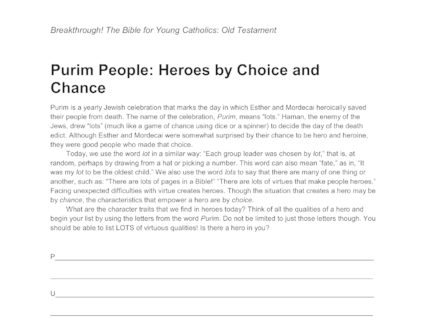
A worksheet that has students list the qualities of a hero by using the letters from the word Purim.
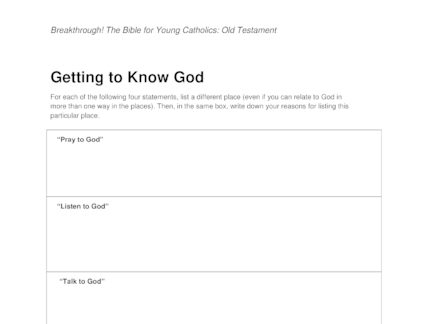
A worksheet for students to list the places they go to pray to God, listen to God, talk to God, and wait for God.
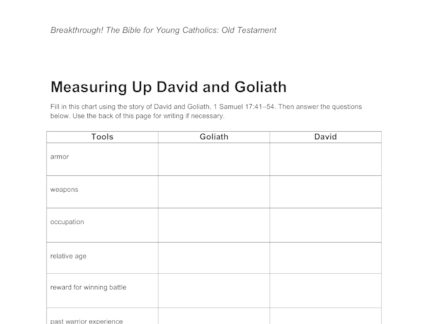
A worksheet where students fill in a chart using the story of David and Goliath as well as answering questions.
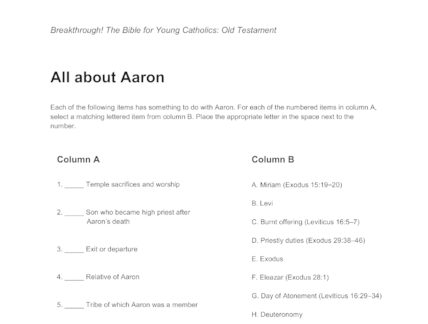
A matching worksheet about items and people that relate to Aaron in the Old Testament.
A worksheet that visually explores the differences between Catholic and catholic.
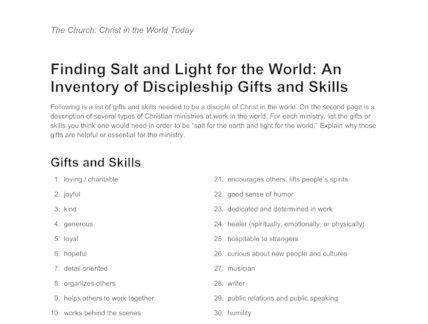
An activity where students are asked to list the gifts or skills that they think one would need in order to be “salt for the earth and light for the world” in a variety of ministries.
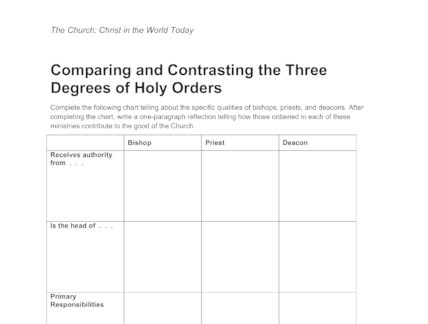
A chart that compares and contrasts the specific qualities of bishops, priests, and deacons.
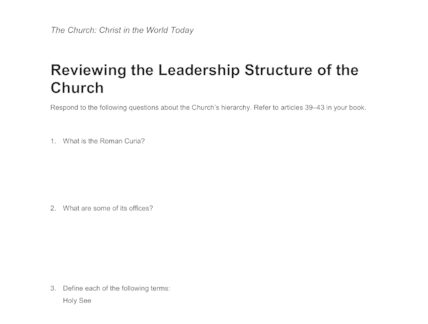
A number of questions on the leadership structure of the Church.
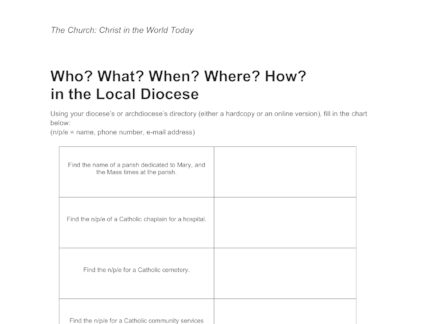
An activity where students are asked to locate information about their local diocese.
A worksheet where students are asked about ordinary charisms and religious charisms.
A worksheet where students are asked to explain each of the seven Gifts of the Holy Spirit and then compose a short essay on instances where the gifts helped them out in difficult situations.
A worksheet where students are asked to define several vocabulary terms related to the Church and write a short essay on which term means the most to them.
A worksheet where students are asked to create a series of teen-friendly podcasts about prayer.
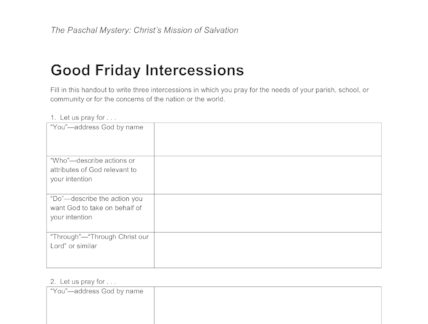
A handout that guides students through writing their own Good Friday intercessions.
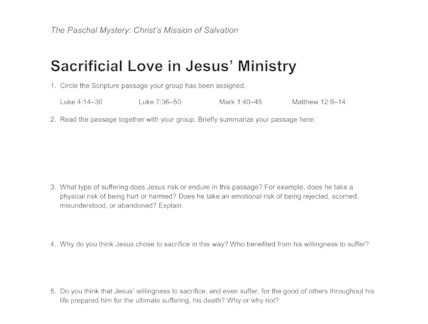
A worksheet where students are asked to read a Scripture passage, identify the type of suffering that Jesus risks or endures, and answer several questions regarding sacrifice and suffering.
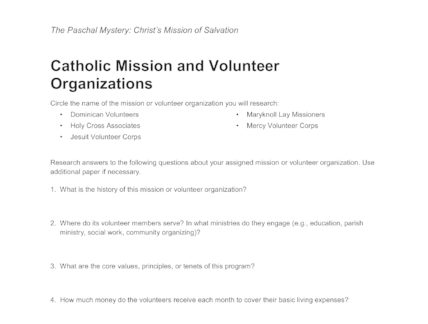
A worksheet where students are asked to research a mission or volunteer organization and answer several questions about their findings.
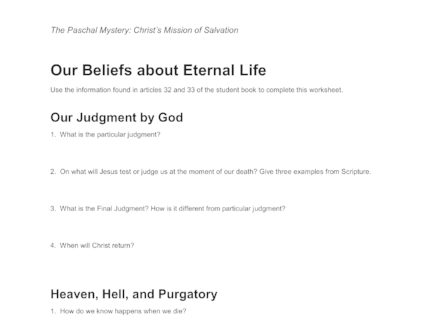
Use the information found in articles 32 and 33 of the student book to complete this worksheet.
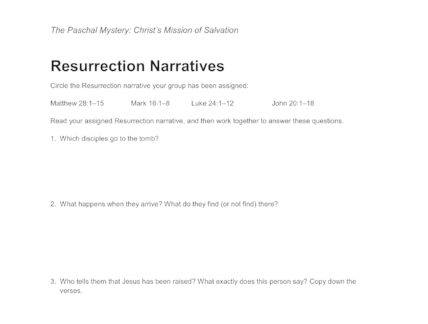
An activity where students are asked to work in groups to answer questions about the Resurrection narratives.
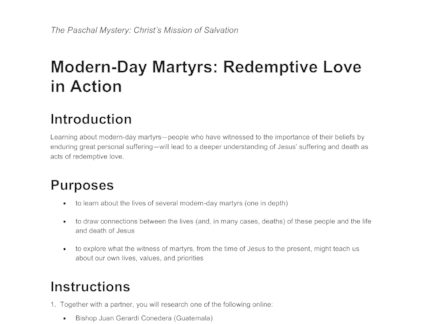
An activity where students will learn about the lives of several modern-day martyrs, draw connections between the lives of these people and the life and death of Jesus, and explore what the witness of martyrs, from the time of Jesus …
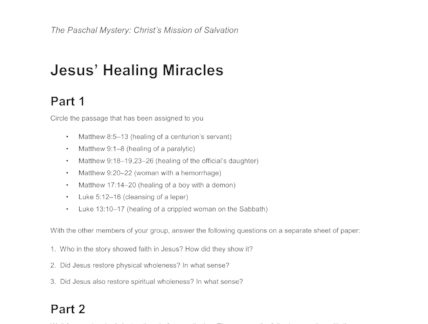
A worksheet where students are asked to look at Scripture passages that focus on Jesus’ healing miracles.
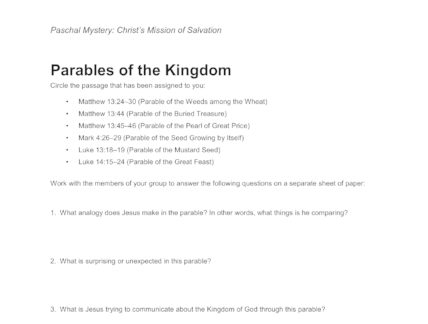
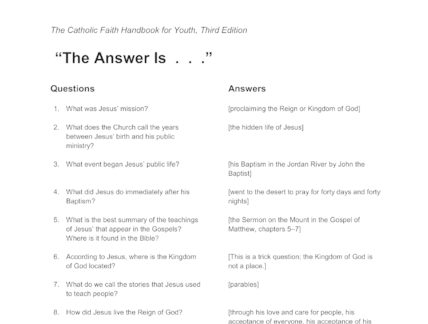
An assignment that looks at what Jesus is trying to communicate about the Kingdom of God through parables.
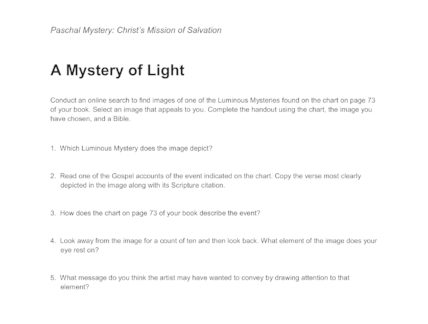
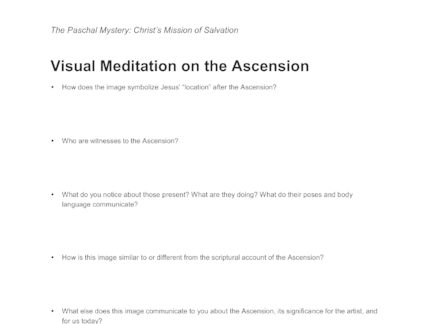
An assignment that asks students to conduct an online search to find images of one of the Luminous Mysteries found on the chart in their textbooks.
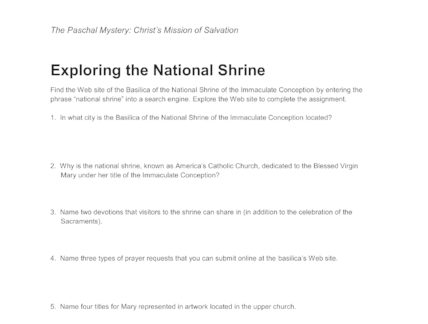
A worksheet asking students to discover more about the Basilica of the National Shrine of the Immaculate Conception by visiting their website.
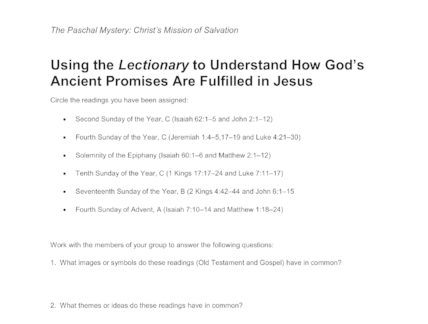
An activity that uses the Lectionary to understand how God’s ancient promises are fulfilled in Jesus Christ.
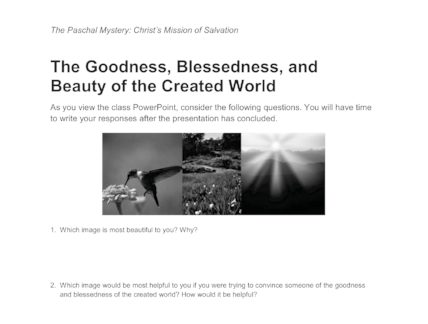
A reflection worksheet on the goodness, blessedness, and beauty of the created world.
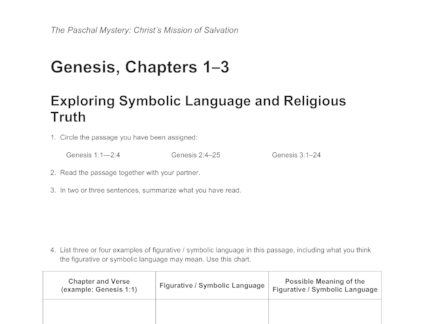
A worksheet looking at the figurative/symbolic language found in Genesis Chapters 1-3, and the possible meanings of the figurative/symbolic language.
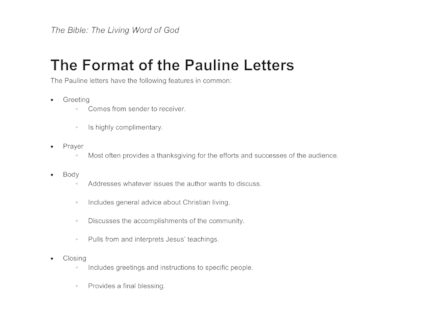
An outline of the features that the Pauline letters have in common.
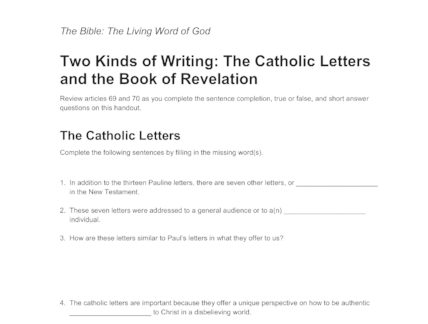
A homework assignment on the Catholic Letters and the Book of Revelation using sentence completion, true or false, and short answer questions.
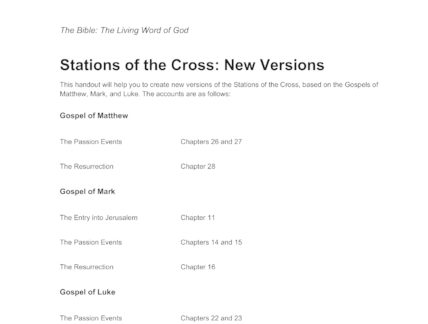
A handout that encourages students to create new versions of the Stations of the Cross, based on the Gospels of Matthew, Mark, and Luke.
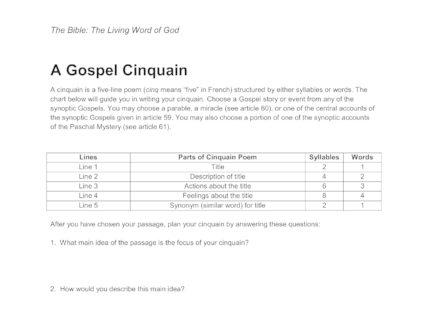
A worksheet where students are asked to write a Cinquain poem based on a Gospel story or event from any of the synoptic Gospels.
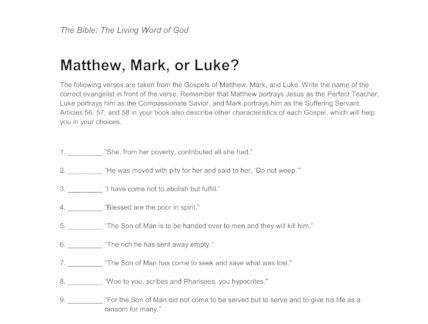
A worksheet where students are asked to match a Scripture passage with the appropriate Gospel writer.
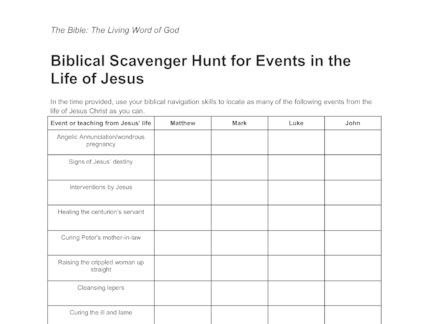
A biblical scavenger hunt for events or teachings from Jesus’ life, using Scripture passages from Matthew, Mark, Luke, and John.
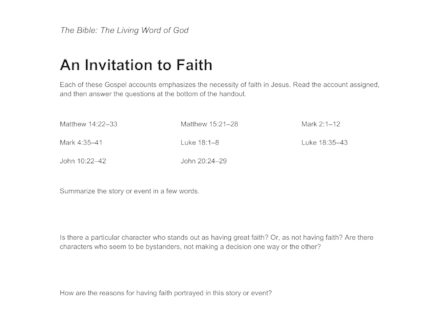
A worksheet where students are asked to read and respond to Gospel accounts that emphasize the necessity of faith in Jesus.
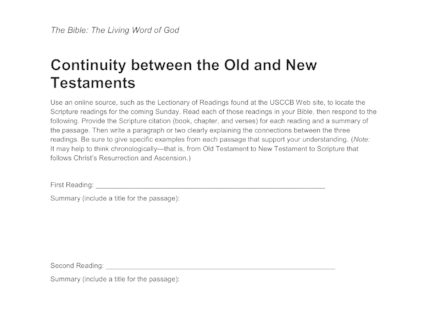
A worksheet on the connection between the Old and New Testaments.
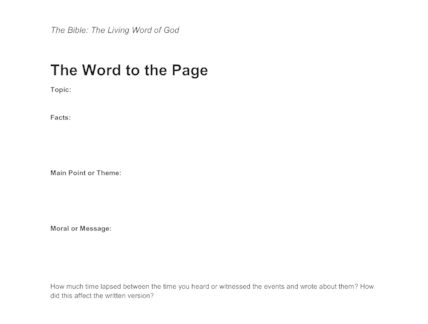
A worksheet on the topic, facts, main point or theme, and moral or message of a chosen event.
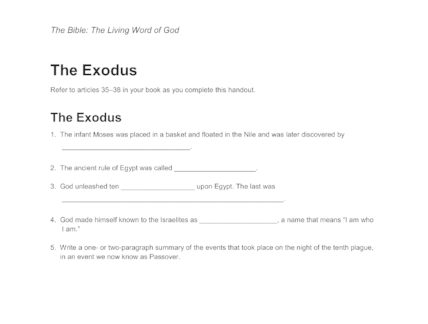
An assignment on the Exodus, comprised of fill-in-the-blank and short answer questions.
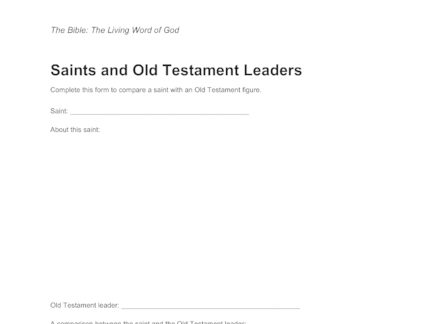
An exercise that compares a saint with an Old Testament figure.
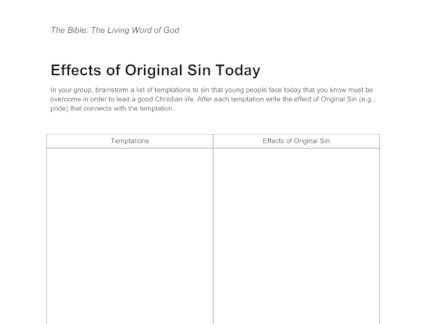
A group brainstorm activity on temptations to sin that young people face today, and the effects of Original Sin.
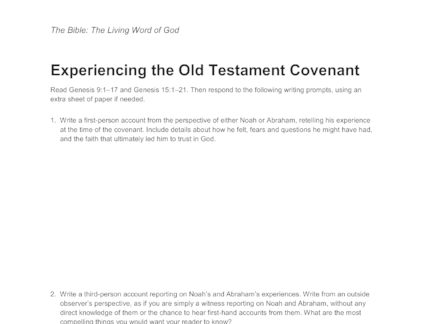
A writing exercise that invites students to experience the Old Testament Covenant.
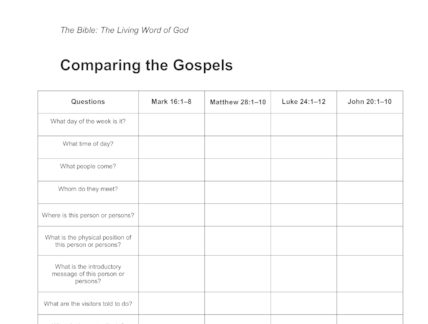
A homework assignment for Section 4 Part 1 of "The Bible: The Living Word of God."
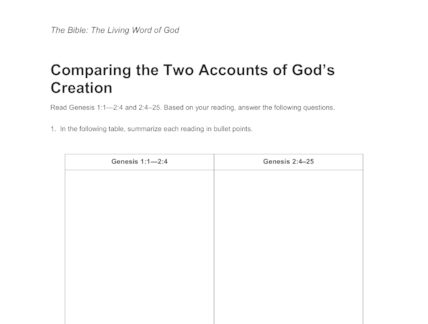
An exercise that asks students to compare the Creation accounts in Genesis 1:1—2:4 and Genesis 2:4-25.
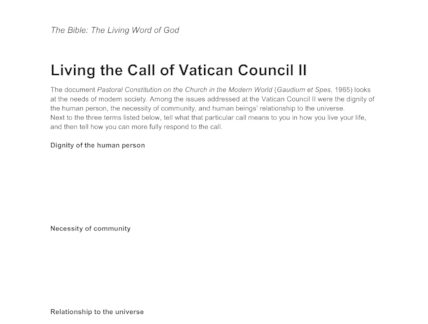
A worksheet that looks at the dignity of the human person, the necessity of community, and human beings’ relationship to the universe.
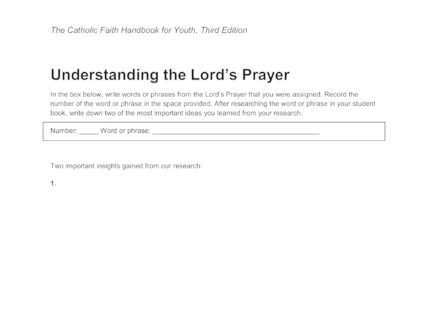
An activity to help students understand the Lord's Prayer from "The Catholic Faith Handbook for Youth" Teacher Guide.
Copyright © 2026 Saint Mary's Press. All rights reserved. • Privacy Policy